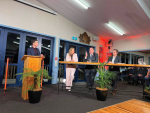
Rural Vote Debate on Q&A: Substance or Just Platitudes?
It was billed as a chance for all the political parties to woo the rural vote, but question marks hang over just how effective this was.
 increase font size
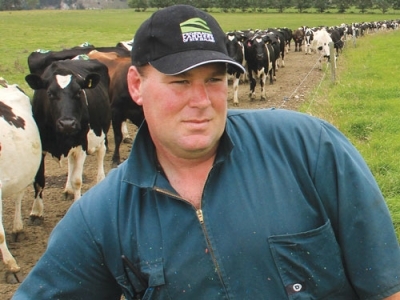 Federated Farmers dairy industry group chair, Andrew Hoggard (pictured), says the results don't come as a surprise.
Dry stock farmers' salaries have seen strong growth in the last year, according to Federated Farmers and Rabobank's 2015-16 employee remuneration report.
Despite tough times and low inflation, most sheep, beef and grain farmers have been able to provide higher average salaries on a year ago - illustrating real income increases for many farm workers at all levels of experience and responsibility.
Salaries in the dairy industry have remained stable, but for the first time there has been a very small decrease in the value of extras farmers provide their staff, such as firewood and internet access, pushing the total value of their package (TPV) down.
Federated Farmers dairy industry group chair, Andrew Hoggard, says the results don't come as a surprise.
"With the dairy extended downturn and low inflation, significant movement up was not expected," he says.
"The value of non-cash benefits being down could reflect the emphasis the industry as put on the importance of ensuring cash salaries are truly reflective of skill level and experience of staff and to avoid using extras to plug shortfalls."
The report also shows that the message on compliance is getting through to dairy farmers - with the number of signed employment agreements and recorded hours on the rise in the dairy sector.
"A number of farmers were caught out last year with insufficient records to prove compliance with minimum wage, however we have seen a large increase in the number of staff whose hours are recorded - which industry bodies have pushed."
"There is also now near saturation across the dairy industry for people having signed employment agreements - with 94% of permanent employees having a written contract in place. Having a signed employment agreement is a basic minimum under employment law."
Hoggard says the report once again highlighted that there has been a decrease in working hours.
"Employees in the dairy industry across all levels are working an average of 46 hours each week, which reinforces the significant drop from 2013/2014 survey, two years ago. This further proves that last years results are a fairer reflection of the average hours worked across the year," says Hoggard.
"People tend to concentrate on hours farm employees work in the busiest time of year and overlook the fact that hours fluctuate markedly from season to season. There are quiet times of the year as well - and the reports findings reflect this."
Hoggard says there is still work to be done - but that this year's results show we are heading in the right direction.
"I'm confident the shift with the stats regarding employment agreements and time recording will spur more farmers into action, though we still need to do better - as we strive for 100% compliance with minimum standards."
The report collated data on 3158 employment positions across 13 different on-farm roles in the dairy, sheep and beef and grain sectors, and showed that the mean salary was up across these sectors by 0.8% for dairy employees, 1.3% for sheep and beef employees and 1.3% for grains employees.
It was billed as a chance for all the political parties to woo the rural vote, but question marks hang over just how effective this was.
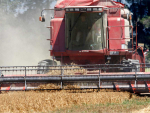
Mid Canterbury Federated Farmers arable chair, Bevan Lill, said Beef + Lamb NZ data indicated that for the last six years, the average arable return on investment was about 0.8% while inflation ran about 4% - so the average arable farm was going backwards at about 3% a year.
For the first time in a quarter of a century, Federated Farmers has something positive to say about the Labour Party’s climate change policy leading into a general election.
Rural leader Mark Hooper has been appointed as an independent director to the NZPork board, bringing extensive farming, governance and advocacy experience to the role.
There's been widespread support from the primary sector for the Government's announcement on changes to freshwater farm plans that come under the Natural Environment Bill, which is now set to replace the existing RMA.


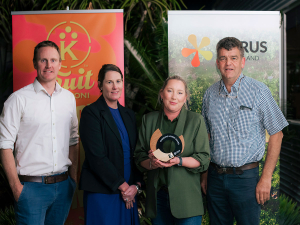
New Zealand's citrus growers were challenged to build their future on the value embedded in their fruit rather than the volume they produce, at Citrus New Zealand's annual gathering in Gisborne on 17 September.

Leading John Deere technicians and apprentices from New Zealand and Australians were recognised at the recent sixth annual JD Technician of the Year Awards, held in Brisbane.
In Dacre, near Invercargill in New Zealand’s South Island, Bruce Dinnington is running a dairy operation unlike any other.
A free online platform aggregating governance vacancies across rural and regional New Zealand has been launched.
Environment Minister Nicola Grigg has announced details of a new rural plastics recycling scheme.
Agricultural drone operators say that a government decision to allow lower-risk drone work without certification won’t lower standards but drive innovation and efficiency.