Arla Foods delivers $15b revenue as Co-op turns 25
European dairy giant Arla Foods celebrated its 25th anniversary as a cross-border, farmer-owned co-operative with a solid half-year result.
 increase font size
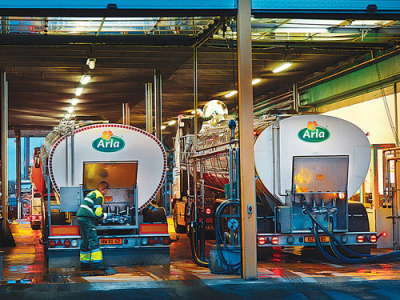 Arla is growing its global business.
European dairy co-op Arla Foods will spend $850 million this year to expand its business.
Arla Foods’ board met in London recently to approve the expansion plan put forward by management; the money will go into new, expanded and improved production capacity as well as innovative technology.
Arla chairman Ake Hantoft says all investments by Arla Foods are made to secure long-term growth and profit for its 11,200 farmer owners across Europe.
“Arla has a history of good investing for sustained growth. The board has decided to increase our investments… because we have identified new projects and investments with short and long term potential for significant return.
“The business growth these investments will create for our company will generate growth opportunities for our farmer owners. We see the investments as essential to the future of our business.”
Arla grew 50% in the last decade and now operates in 120 countries. It has three key areas in view for investment: meeting the growing demand for dairy, healthy and natural products that match consumer lifestyles; leading in whey; and sustainable food production.
While global milk production continues to be volatile, dairy consumption worldwide is growing faster than it ever has.
About 50% of the new investment will be on projects aimed at growing Arla Foods’ sales outside Europe; its fastest growing markets are Middle East and North Africa, China and Southeast Asia, Sub-Saharan Africa and the US.
Two thirds of this year’s spending will be to raise Arla’s European production capacity: $450m in Denmark, $140m in the UK, $130m in Sweden and $110m in Germany; $60m is earmarked for production in other countries.
The aim is to grow the co-op’s positions in key dairy categories and markets where Arla is already a key player, says chief executive Peder Tuborgh.
“Our ambition is to create an even stronger foundation for our farmer owners and our future business growth.”
European dairy giant Arla Foods celebrated its 25th anniversary as a cross-border, farmer-owned co-operative with a solid half-year result.
The creation of Europe's largest dairy co-operative should be complete by early 2026.
OPINION: One of the world’s largest dairy co-operatives has come under fire for embracing a new methane-reducing additive fed to cows. The claims, made on social media, says the use of a feed additive by Arla Foods farmers could ‘contaminate’ milk and allegedly cause cancer.
European dairy co-operative Arla Foods is forecasting a total revenue of nearly $25 billion this year.
Danish dairy co-operative Arla Foods is accelerating sustainability efforts on farm to help customers achieve their reduction targets for scope 3 emissions targets.


Now in its fourth year, the 2026 Fencing Industry Awards, formed part of the proceedings of the FCANZ Conference, held in Nelson during August.
DairyNZ deputy chair Cameron Henderson has been re-appointed unopposed for another term.
OPINION: The stats speak for themselves.
Farms across the upper North Island are trialling different pasture mixes as part of a research programme that aims to build greater resilience into farming systems.
Election years are always a concerning time for farmers, according to DairyNZ chair Tracy Brown.
The Ballance Farm Environment Awards are coming to the West Coast of the South Island.