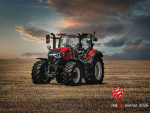
Case IH Unveils Next Generation Puma Series Tractors
Case IH has unveiled its redesigned next generation Puma Series tractors, said to offer improvements in connectivity, operator comfort, fuel efficiency and drivability.



 increase font size
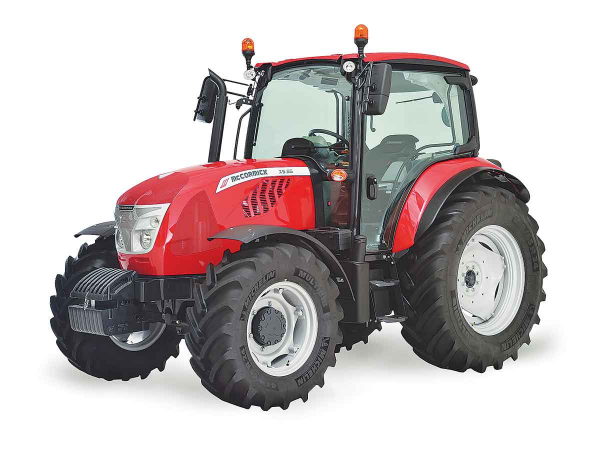 The new X5 Series is offered in three models.
A new generation of McCormick tractors, aimed at livestock operators, is now available in New Zealand.
The new X5 Series, offered in three models, is powered by a 3.6-litre Deutz four-cylinder engine – delivering max outputs of 99hp (X5.35), 110hp (X5.45) and 113hp (X5.55).
All models feature a simpler emissions control system in the form of a diesel oxidation catalyst (DOC).
This, unlike a diesel particulates filter (DPF), requires no fuel-burn offs to clean, no maintenance and no operator intervention.
Power is channelled through a new 24x24 transmission with a splitter operated by a button on the gear selector. This permits easy up-and-down-shifts to cope with changing loads. In addition, the new Eco Forty feature offers reduced engine revs once a 40km/h cruising speed has been attained – saving fuel and reducing noise.
A four-speed PTO system also helps save fuel, by offering an economy setting for each of the normal 540 and 1000rpm speeds.
The hydraulics see a 63-litre/min gear pump (complemented by a 32-litre/min pump dedicated to steering and ancillary clutches), supplying the three, double-acting spool valves fitted as standard.
Meanwhile, a separate, dedicated 32l/min pump looks after power steering and transmission lubrication.
Other standard equipment in the X5 Series range includes interchangeable ball and claw ends for the 4500kg rear linkage lift arms, electronic rear hitch control, air suspension seat and a tilt and telescopic steering wheel.
Case IH has unveiled its redesigned next generation Puma Series tractors, said to offer improvements in connectivity, operator comfort, fuel efficiency and drivability.
Italian tractor manufacturer Argo Tractors, builders of the McCormick, Landini and Valpadana marques, has opened a new factory to develop and manufacture transmissions for those brands.
After 12 years of representing the Landini and McCormick brands in New Zealand, Bay of Plenty-based AGTEK and the brands’ manufacturer have mutually decided to wind up their long-standing agreement.
A total of 108,800 tractors were registered across Europe in the first six months of 2022, with 31,900 tractors of 37kW (50 hp) and under and 76,900 of 38kW and above.
Choosing the right new vineyard tractor is an important decision, given the major capital outlay.


Federated Farmers has welcomed new rural policies released by ACT, saying they align closely with its own election priorities.

Rural Contractors NZ says proposed changes to land transport rules for agricultural vehicles are a welcome response by the Government to out of date regulations which have seen members hit with huge fines.
Alliance is calling for final applications for its 2027 Graduate Programme, with applications closing on Sunday 25 October.
Decades piloting planes has ensured vet and farmer David Hayes is focused on safety. So, after a serious accident while welding on farm, he is sharing his experience so others can learn from it.
Canterbury milk processor, Synlait Milk has confirmed Leon Fung as its chief executive officer.
OPINION: Making it easier to collect rainwater and use it to grow crops and livestock is a no brainer.




