Fonterra's New Roadmap Targets Climate, Nature, Animals
Climate, nature and animal wellbeing make up Fonterra's refreshed sustainability roadmap released last week.
 increase font size
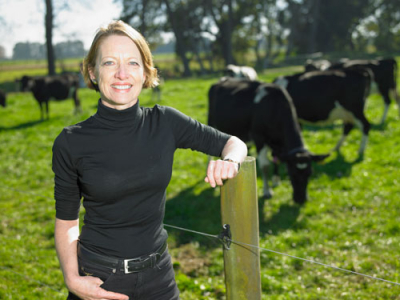 Jacqueline Rowarth.
News last month that hill country greenhouse gas (GHG) emissions are lower than previously estimated is ‘interesting’.
Although farm animals aren’t included in New Zealand’s Emissions Trading Scheme (no country has put agriculture in to any sort of GHG scheme), many people still point fingers at ‘polluters’ and regard the animals and their owners as free-loaders.
This is odd when one considers how much of the economy, and hence the lifestyle of most of NZ society, relies on those animals, and the efficient management of the, which helps maintain low food costs. The latest Household Income Survey from StatisticsNZ makes the point.
In the three years June 2013 to June 2016, average household income increased 11.7%. Food accounts for 16.8% of household weekly spending and it increased 14% from 2013. Within the food category, however, the major increase (28%) was in ‘restaurant meals and ready-to-eat food’. More people are eating out (51.5%, up from 43.3%) and it is costing them more, mostly because of salaries, power and real estate – not the basic food ingredients.
In addition, more of the weekly spending is on transport – up 23.4% from 2013. Air transport -- international and domestic -- benefitted, and a quarter of households bought cars. Headlines declaring that SUVs in NZ are now the most common purchase indicate that GHGs are not top-of-mind in decisions.
But overall, NZ produces less more than 2% of global GHG emissions, so people are getting out there and enjoying life.
The same rationale on ‘small contribution’ is not being applied to agriculture, which contributes less than 1% of global emissions, but provides the protein requirements of about 45 million people (according to Massey University’s Riddet Institute).
In contrast, the rest of the GHG emissions by NZ support the fuel and power needs of only 4.7m residents plus tourists from overseas.
Kiwis can decide not to launch their jetski or turn on their air-conditioning, thereby reducing GHG contribution. In contrast, turning down agricultural emissions means altering biology – or getting rid of animals. Environmentalists have suggested this as a route to a more sustainable future, however, over 95% of NZ does not suit horticulture or cropping. In addition, cultivation tends to increase carbon dioxide losses from the soil to the environment as organic matter breaks down; it also increases the potential for erosion.
At stake is the contribution of pastoral agriculture to the export economy. Animals turn the pasture that clothes the landscape into protein that humans can digest, and people overseas pay for that protein. Arguably they don’t pay enough, but milk and meat are still the main source of new money into NZ.
Suggestions that NZ should switch to ecological farming on the basis that doing so would be profitable, reduce emissions and protect soil and water are also misleading. Ecological farming has been shown to do what is claimed for it in comparison with subsistence farming. It does not, however, do so in comparison with developed agriculture. In particular, to achieve the same overall production, more land is required and more GHG are produced.
Over the last 20 years, emissions efficiency of production in NZ has increased by about 1% per year by improving feed and nutrition, animal genetics, pasture management and animal health. A report this year from the Parliamentary
Commissioner for the Environment on ‘Climate Change and Agriculture: understanding the biological greenhouse gases’ discusses what can be done in the future. It makes it clear that more research, such as that on hill country emissions, is required.
The New Zealand Agricultural Greenhouse Gas Centre, in Palmerston North, is doing its best. Researchers funded by the centre have made considerable advances in identifying vaccines, feeds and animal genetics with potential to make a difference.
While the research continues, NZ agriculture is doing what it has always done: improving efficiencies and supporting the economy. By doing so it enables NZers to do what they have always done – eat good food and enjoy it.
• Jacqueline Rowarth is chief scientist, Environmental Protection Authority. The EPA operates and maintains the New Zealand Emission Unit Register.
Climate, nature and animal wellbeing make up Fonterra's refreshed sustainability roadmap released last week.
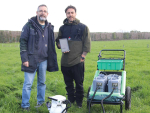
Researchers at Massey University are using a special piece of scientific equipment to improve the measurement of greenhouse gas emissions from pasture soils.
A hypothesis in a major dairy research programme that bulls genetically proven to be low methane producers could pass this trait onto their lactating daughters has been proven to be incorrect.
New research suggests sheep and beef farmers could improve both profitability and emissions efficiency by increasing lamb weaning weights, with only marginal changes in total greenhouse gas emissions.
Reducing emissions is a constant battle at Yealands Wines in the Awatere Valley, with nearly 20 years chipping away at carbon.



Dr Scott Champion, Foundation for Arable Research chief executive, says that everyone in the supply chain had a role to play in driving the sector's long-term success.
The Minister for Rural Communities, Mark Patterson, says there's a massive infrastructure deficit in rural areas.
New Zealand's red meat and fifth-quarter exports reached $867 million in August, up 23% on the same month last year, as stronger returns lifted earnings across all major markets.
State farmer Pāmu is bracing for a $30 million hit from soaring farm input costs this financial year.
Flat pricing in the face of significant increases in costs is the greatest problem facing the arable sector, says Foundation for Arable Research (FAR) chief executive Dr Scott Champion.