Transmissions factory for big brands
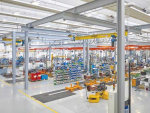
Italian tractor manufacturer Argo Tractors, builders of the McCormick, Landini and Valpadana marques, has opened a new factory to develop and manufacture transmissions for those brands.
 increase font size
 A McCormick X7 VT-Drive.
It's taken Argo a while, considering the re-birth of McCormick took place in 2001, but the company has recognised the need for a 'vario' type tractor and launched the X and-VT range.
Continuously variable transmissions (CVT) – or varios – have found increasing favour especially with contractors who need continuous adjustment of speed during, say, harvesting, baling or transport work. There a conventional fixed ratio power shift set-up might not offer the exact speed required.
The McCormick VT range has three, 4-cyl models from 144 to 166hp, with 'power boost' in PTO and transport work taking output to 175hp. Also offered are two 6-cyl units rated at 165 and 177hp, with 'boost' giving a maximum of 192hp.
For the VT project the company has partnered with transmission industry leader ZF, whose latest Terramatic unit
has software developed by Argo.
Product specialist Paul Wade says "the design brief was to make the VT easy and intuitive to drive. First time users can jump on and drive away, and over time explore the tractors' sophisticated features".
In operation the VT system offers four driving modes:
auto – push the pedal and go, just like the family car
manual – upper and lower engine speeds are set and the driver controls the travel speed. This is useful for keeping the tractor in a power band that exploits the torque and power available, so would be good for heavy draft work
Cruise control for constant speed
PTO mode which maintains shaft speed and adjusts travel speed as load demands.
Supplementing the four driving modes are four speeds bands – 0-3km/h, 0-12km/h, 0-21km/h and 0-40 or 50km/h – which can be pre-programmed for specific tasks. It is interesting to note that the change between each of the speed ranges is seamless, unlike some other two range systems on the market that require the tractor to be stationary before the change can be made.
The cabin and drivers spaces focuses on ergonomics; a noatable feature is a seat mounted control console with a 12 inch touch screen displaying transmission, engine, PTO and hydraulic functions, and optional display of GPS and ISOBUS control through the same screen
Generally the rest of the tractors' specifications are the same as the semi-power shift X7 Pro-Drive models introduced last year, with features such as 9300kg lift capacity, 123L hydraulic flow via a load sensing system, and a total of up to 4 rear and 2 mid-mount remotes.
Expect to see first models in NZ mid 2016.
Italian tractor manufacturer Argo Tractors, builders of the McCormick, Landini and Valpadana marques, has opened a new factory to develop and manufacture transmissions for those brands.

The judges at last year’s Agritechnica event picked the Italian-built Landini Rex 4-120GT Robo- Shift Dynamic as the Best of Specialised category at its Tractor of the Year 2024 Awards.
After 12 years of representing the Landini and McCormick brands in New Zealand, Bay of Plenty-based AGTEK and the brands’ manufacturer have mutually decided to wind up their long-standing agreement.
Norwood and ARGO Tractors, the Italian manufacturer of Landini and McCormick tractors, have announced an agreement that gives Norwood exclusive distribution rights for the New Zealand market.
A new generation of McCormick tractors, aimed at livestock operators, is now available in New Zealand.

During the nesting season, from September to December, industrious starlings can quickly build nests in the darker areas behind tractor and vehicle, usually close to hot engines, typically resulting in localised damage or in some cases complete write-offs.
The meat processing industry is much more collegial than it was in the past and is now more focused on common goals.
With the last couple of months having seen some potential tractor purchases put on hold with the impending election and continued input cost rises, year-to-date figures, ending September, has seen deliveries up around 5% over the same period in 2025, with a total of 2026 units.
Beef+Lamb New Zealand is calling for nominations for director roles in the Northern South Island and Northern North Island electoral districts.
Fonterra chief executive, Richard Allen says being resilient has helped the dairy industry overcome extreme volatility in recent years.
The head of the Ministry for Primary Industries (MPI) trade and international relations group says New Zealand is well-positioned to secure trade access and compete internationally as the world becomes more complicated, demanding and uncertain.