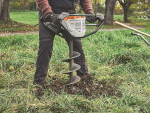
Stihl Launches BT140, Its First Battery-Powered Auger
With battery tools becoming more widespread and more importantly, productive and reliable, it was only time before we saw augers or post-hole borers.
 increase font size
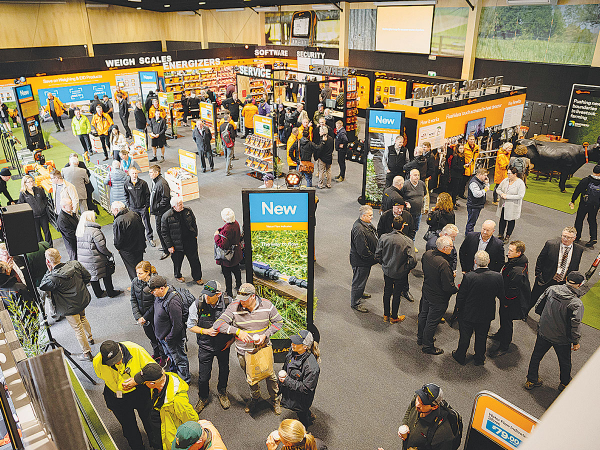 Gallagher's 2019 Fieldays site.
The rapidly expanding 'virtual farming' arena looks like it's taking a step nearer reality with Hamilton-based Gallagher Group taking ownership of Australian virtual fencing developer Agersens.
Best known for its eShepherd system, Gallagher has been a minor investor in Agersens since 2016. It suggests that the acquisition will allow it to develop the technology further and drive commercial expansion in Australasia and beyond. The technology is a result of the original, licensed intellectual property - developed by the Commonwealth Scientific and Industrial Research Organisation (CSIRO) - that demonstrated how cattle can be trained to stay within "virtual" boundaries using a combination of audio signals and aversive electrical pulses.
The system is designed to allow farmers to control the location and movement of cattle via a web-based application and a solar powered, counter-weighted neckband, connected to the internet via a base station. Boundaries can easily be drawn around entire properties or selected areas within a property, using a tablet or smart device, while also offering real-time information of individual animal locations.
In practice, when an animal moves towards the 'virtual' fence, they are given an audible warning. If they fail to back away, they are given an electrical pulse that is less than that of an electric fence - causing discomfort rather than harm. Animals are said to quickly learn to respond to the audible cue alone before any electrical pulse is required.
Recent fully-subscribed trials in New Zealand and Australia have shown that the system is particularly effective when used in rotational grazing.
It removes the risks of over/under grazing as well as helping to reduce the environmental footprint by excluding animals from sensitive areas - such as streams, rivers or riparian plantings.
With battery tools becoming more widespread and more importantly, productive and reliable, it was only time before we saw augers or post-hole borers.
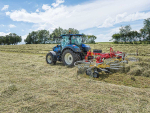
Austrian manufacturer Pottinger has released details of a new compact, linkage-mounted compact twin rotor rake, without a chassis, that is said to deliver impressive manoeuvrability.
The new Lemken Saphir XMR mechanical seed drill has been introduced as the successor to the proven Saphir 10m, with the manufacturer claiming new standards for precision, ease of use and area coverage.
Krone's XDisc 710 direct-cut header can now be used by John Deere and New Holland forage harvesters, as well as the Krone Big X it was originally designed for.
Fifty Eight years ago, on the 16th of August 1968, August Claas, the founder of the harvesting company and father of Helmut Claas, personally presented a Claas Senator combine harvester to Scottish farmer John Steven.

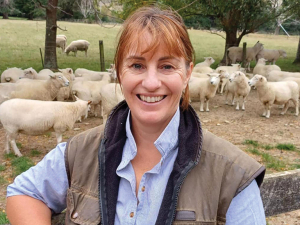
B+LNZ's Wormwise veterinarian Mary Bowron has won the Best Sheep and Beef Vet of the Year Award in recognition of her outstanding contribution to New Zealand’s sheep and beef sector.
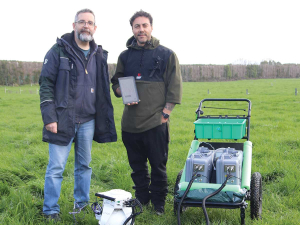
Researchers at Massey University are using a special piece of scientific equipment to improve the measurement of greenhouse gas emissions from pasture soils.
More signs of a booming kiwifruit sector.
OPINION: David Seymour and James Meager's plan to make it easier for farmers and orchardists to operate drones can best be described a 'courageous' move.
New Zealand wool is reaching new heights as air filtration companies move away from synthetic products to biodegradable alternatives.
Opuha Dam's ability to protect South Canterbury communities from major flooding has taken a significant step forward, with Opuha Water Limited (OWL) successfully commissioning a new outlet valve capable of releasing record volumes of water from the dam ahead of a weather event.