Costly Utterances
OPINION: A costly out-of-court settlement has hit dual-listed processor a2 Milk Company.
 increase font size
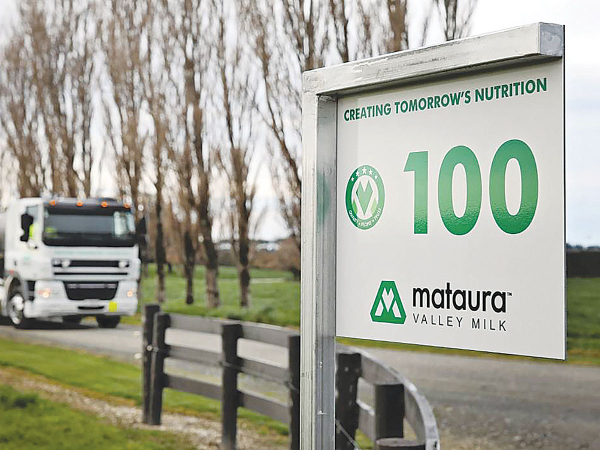 Mataura Valley Milk (MVM) sales were up 9.2%, however the processor reported an EBITDA loss of $26.5 million.
The a2 Milk Company (a2C) efforts to return its Southland-based subsidiary Mataura Valley Milk to profitability remains a work in progress.
However, a2C has delivered a strong result for the 2023 financial year – on the back of success in the China infant formula market. It recorded double digit growth in revenue and earnings for the year ending June 30, 2023. Revenue jumped 10.1% to $1.6 billion.
China and ‘Other Asia’ segments sales rose 38%. Infant milk formula (IMF) sales were up 8.4% with China label sales up 27.8%. EBITDA was up 11.8% to $219.3 million and net profit rose 26% to $145m.
Mataura Valley Milk (MVM) sales were up 9.2%, however the processor reported an EBITDA loss of $26.5 million, compared to a reported loss of $18.8 million in FY22. The MVM plant, which started processing milk in August 2018, was built by the China Animal Husbandry Group: a2MC bought a 75% stake in the company in July 2021 with CAHG retaining 25% share.
In its annual results last week, a2C noted that MVM’s net sales for the last financial year reached $114m. It recorded an EBITDA loss of $26.5m, about $4m higher than the previous year.
The company says MVM’s slightly higher EBITDA loss was due to the timing of sales in a volatile commodity and foreign exchange environment; reduced demand from third-party customers in China; increased investment in capability; significant product development trials; and investment to support future nutritional powder production.
“Accelerating MVM’s path to profitability by FY26 or earlier is a key strategic priority for the company,” says a2C.
a2C managing director David Bortolussi says MVM has also commenced an on-farm methane inhibitor feasibility study, via a research agreement with Lincoln University.
Bortolussi says MVM is also developing a sustainable packaging roadmap.
Commenting on a2C’s annual results, Bortolussi says he’s proud of what the team has achieved this year.
“Growing sales by 10% while the core China IMF market declined by 14% is a remarkable achievement.
“Our China label IMF sales exceeded English-label sales for the first time, and our total IMF sales were over $1.1 billion, making us a top-3 share gainer in the market overall.”
Bortolussi says the Daigou market in English-label IMF declined sharply again this year by almost 40% and a2C has pivoted to more controlled channels.
OPINION: A costly out-of-court settlement has hit dual-listed processor a2 Milk Company.

OPINION: What does the birth rate in China have to do with stock trading? Just ask a2 Milk Company.
Two large milk processing plants in New Zealand are changing hands.
OPINION: Nearly four years after buying a 75% stake in Southland processor Mataura Valley Milk (MVM), A2 Milk is still struggling to take the plant to profitability.
The a2 Milk Company (a2MC) is launching a new round of grants to support projects aimed at enhancing dairy farming sustainability via the a2 Farm Sustainability Fund.
New Zealand dairy farmers are set to be the first in the world to receive access to a new digital physical milk pricing tool that enables them to fix the price for their physical milk.
State farmer Pāmu is opening its farm gates this summer in an effort to give the rural sector the opportunity to see how large-scale, multi-system farming is delivering productivity and profitability across New Zealand.
A five-year study has found that the cost of reducing emissions without technology may be significant and unsustainable for Northland dairy farmers.
DairyNZ says Waikato farmers need certainty on Plan Change 1, but they say that certainty must be matched with practical, workable rules and a clear transition that doesn't get ahead of the new resource management system currently under review.
While the Government has moved quickly to make commercial hauliers' lot easier during the current fuel crisis, they appear to be stuck in the creep box when it comes to the agricultural industry.
Waikato farmers have been told that the Government’s new planning system legislation and the region’s Plan Change 1 (PC1) “won’t mesh together very well”.