Fonterra FY26 Results: $9.69 Milk Price, $3.4bn Profit
Fonterra has unveiled its annual results for the 2026 financial year, posting $27 billion in revenue and close to $20 billion returned to New Zealand farmer owners and unit holders.
 increase font size
 Fonterra chair John Monaghan.
Fonterra is rejecting a Government proposal for five-metre fencing setbacks on all dairy farms.
Co-op chairman John Monaghan points out farmer shareholders pledged six years ago to fully fence defined waterways on every farm.
“Within 24 months, more than 90% of those waterways were fenced,” he said.
“It’s something we should all be proud of. Instead this proposal punishes us for being proactive with little added benefit and at huge cost.
“Pulling down fences and making farmers start again shouldn’t be a priority.”
In a note to farmer shareholders last week, Monaghan described the proposed five-metre fencing setbacks as “unacceptable”.
Also unacceptable to the co-op is the Government’s proposal to set ‘bottom lines’ for dissolved inorganic nitrogen (DIN).
Monaghan believes the bottom lines for nitrogen and phosphorus in rivers need to be tailored.
“The proposal must consider local contexts or ambitions, and should be backed up by analysis of the economic cost to individual farmers, our communities and wider regional economies,” he said.
“In the current proposal, farms in some parts of New Zealand would have to make nitrogen reductions in excess of 50%. We would expect robust analysis to justify this decision.”
Monaghan says Fonterra supports the Government’s overall goal to improve freshwater.
“Every dairy farmer understands the importance of freshwater to our businesses and our communities,” he says. “We all know NZ can have both healthy freshwater and a thriving agricultural economy.”
But he wants people to take the emotion out of the debate and make these critical decisions based on science, data and facts.
“There is a lot of emotion on all sides of this debate, and rightly so. New Zealanders are passionate about the environment. But at the end of the day we all want the same thing: clean, thriving freshwater existing alongside a thriving farming economy.
“There are a number of proposals we support and we will work with you to help you meet these.”
In particular, Fonterra welcomes the Government’s acknowledgement of the value of farm environment plans (FEPs).
It wants the Government to go further and make them mandatory for all farmers and growers. About 23% of Fonterra farmers already have a FEP tailored to help them farm within environmental limits.
“Continuing to help farmers get FEPs to identify improvement areas will be far more effective in restoring freshwater quality,” Monaghan said.
Fonterra's commitment
• Farm within regional environmental limits
• Encourage strong environmental farming practices
• Reduce water use and improve wastewater quality at manufacturing plants
• Work together on waterway health
• Invest in science and innovation to find new solutions
• Make the products people value most.
Fonterra has unveiled its annual results for the 2026 financial year, posting $27 billion in revenue and close to $20 billion returned to New Zealand farmer owners and unit holders.
Fonterra Co-operative Group has confirmed the independently assessed candidates standing for election to its board in 2026.
Fonterra has revised its Farmgate Milk Price forecast for the 2026/27 season, lifting the midpoint and narrowing the range on the back of improving global dairy commodity prices.
Outgoing Fonterra Co-operative Council chair John Stevenson says that it has been a privilege to represent the co-op's farmer shareholders.
OPINION: It seems Canterbury processor Synlait is still in the doldrums.


Federated Farmers says it welcomes Labour's commitment to reviewing the Sharemilking Agreements Act, calling on other major parties to do the same.
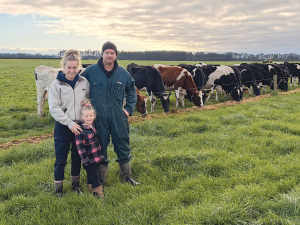
For Canterbury dairy farmers Sian Meijer and Rick Wobben, wearable technology has become one of their most valuable on-farm tools - helping manage 1850 cows across an expansive, high-performing dairy operation while improving efficiency, mating outcomes and day-to-day decision making.
Fonterra has unveiled its annual results for the 2026 financial year, posting $27 billion in revenue and close to $20 billion returned to New Zealand farmer owners and unit holders.
The first major update to the Dairy Cattle Code of Welfare in more than a decade has been released, marking what DairyNZ describes as an important step in ensuring animal welfare standards continue to evolve alongside scientific evidence and on-farm realities.
Ravensdown shareholders have elected Jane Montgomery and Kate Acland to the Ravensdown Board for three-year terms, following a closely contested director election.
Federated Farmers says new legislation replacing the Resource Management Act will cut red tape, unlock investment and help grow New Zealand's export-led economy, after the Planning Bill and Natural Environment Bill passed their third reading in Parliament yesterday.