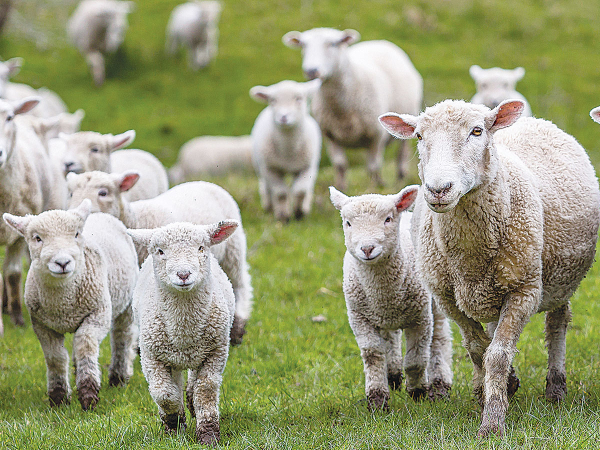
Ewe feed requirements lift markedly in the last month before lambing.
A 65kg ewe with 4kg twins on board should weigh at least 78kg the day before she lambs. As well as her babies, she's carrying about 4-5kg of fluid and placenta, and a kilo or more of udder.
Our ewe in the example above needs to harvest the equivalent of two big black rubbish bags of grass every day before she lambs. She can probably manage this in a controlled grazing system prior to lambing if she is happy and healthy and can spend most of the day grazing. Or if she's on a crop where she can easily harvest this feed and then spend the rest of the day munching on fibre.
Once she lambs, her feed requirements go up by another 30-50%. Our ewe who was eating around 2kg of drymatter pre lamb now needs to eat 3-3.5kg to milk to her potential. This is threeplus rubbish bags of grass, and this becomes a stretch on short grass systems.
An AgResearch comparison of stocking rates at lambing in the Wairarapa found that for late August/early September lambing dates, every 100kg DM/ha lift in set stocking pasture cover resulted in an extra 2kg of lamb weaning weight. Ewes also weaned heavier in these groups. That’s worth doing a feed budget for! Late-September lambing ewes were not affected the same by pasture cover – because growth was keeping up with ewe demand.
Lambing dates well in advance of the spring lift in pasture growth require either very light stocking rates, or plenty of feed ahead of ewes to properly meet their energy demands in late pregnancy and early lactation.
Note the point about late pregnancy; there needs to be scope in the system to increase the intake of twin ewes in the last few weeks before lambing. If the choice is between feeding ewes better before lambing, or saving up feed for after lambing, feed them better beforehand.
Singles don’t require this amount of love, and triplets should be fed ad-lib from scanning onwards (except the very fat ones, but don’t underfeed these in the last two weeks – phew, this is complicated!).
Timing of set stocking is important. If you setstock too early, ewes will eat more than they need and drop the pasture cover in their paddocks to a level that restricts intake – right when they need more to eat. With multiple ewes, it can be smart to get their animal health treatments done a bit earlier, so they don’t get a feed pinch close to lambing. But rather than set-stock at that point, keep them rotating until closer to their due date.
So back to the original question on set stocking numbers! Ideally, we want our multiple ewes to maintain covers in their paddocks of 1200kgDM/ha or more. This is 3 to 4cm of winter- grown grass.
If we set stock onto a cover of 1200kgDM/ ha and we don’t want to drop it, our set stocking rate needs to set a daily demand from the ewes that is about equal to the pasture growth rate.
For twin ewes eating 3kgDM/day, at 10 ewes/ha we need grass to be growing at 30kgDM/ha/day. When does your grass start growing that fast? Typically, not in August, and in many parts of NZ, not until later in September or even October. However, in this scenario, at 5 ewes to the hectare, we can cope with a pasture growth rate of 15kgDM/ha/day.
The set stocking rates I hear talked about, and see on farms, are often higher than ideal to maximise ewe milk production and future lamb growth, as pastures drop well below the ‘grass grows grass’ level.
Spending some time now doing your own numbers (or getting someone to help you) will be a great investment this year. With projected good product prices, investment in growing more feed, using supplements or lightening the load by making earlier sales of other stock classes, to feed ewes to potential, is a no-brainer.
Ginny Dodunski is a vet and Wormwise programme manager.