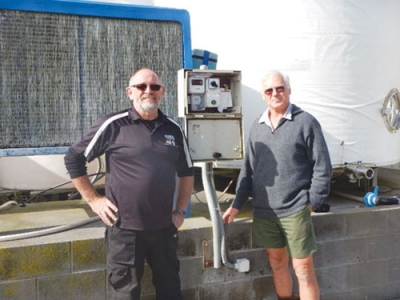
The simplest ideas are often the best, and so is the case with the CSL Chillboost, with potential to save dairy farmers money as they strive to meet the new milk cooling rules.
Milk in the vat must now be cooled to 10 degrees C or below within four hours of the start of milking, or down to 6 degrees C or below within six hours, and within two hours of completion of milking.
The milk must be held at 6 degrees C or below until collection or the start of the next milking, and must not exceed 10 degrees C during subsequent milkings.
The Chillboost device designed by Brad Sulzberger, a dairy farmer from Urenui, Taranaki, is aimed at this last point -- the 10 degree C threshold when adding fresh milk to the vat.
Typically milk already held in the vat will be between 4 and 6 degrees C at the start of milking, with 4 degrees C being the switch-off point, and 6 degrees C being the cut-in point for the chiller system.
In effect the device is a waterproof timer, encased in a module, which uses a shunt to connect to a thermo-couple that can be set to activate the chiller system around 30 minutes before the start of milking; this 'tricks' the chiller unit into registering the milk as being warmer than it really is.
This allows the chiller to bring the contents of the vat down to 4 degrees C or below prior to milking, and goes on to repeat this cycle every 30 minutes, and as milk is added it keeps the 'blend' temperature lower than normal.
In practice this means the chiller will never wait to see the cut-in temperature of 6 degrees C, and will have the overall effect of reducing the blend temperature by around 2 degrees C, which for a large number of dairy farmers will allow them to stay under the 10 degree C blend temperature, as required under the new rules.
The unit can be retro-fitted to existing chiller systems and offers the advantage of using the milk already in the vat as a cold storage 'bank' to help lower the blend temperature as it enters the vat.
It is easily adjustable to cater for different systems or regimes and lends itself well to two-day pick up cycles.
The unit also enhances the existing chiller performance by maximising its output, delaying the need for an upgrade.
Price: around $200+GST.
www.corkillsystems.co.nz