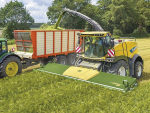
Krone XDisc 710 Now Fits John Deere, New Holland Foragers
Krone's XDisc 710 direct-cut header can now be used by John Deere and New Holland forage harvesters, as well as the Krone Big X it was originally designed for.
 increase font size
 Spreadpoint spreader range.
With applying lime still being the most effective method of correcting soil acidity, it shouldn’t be a surprise to hear that a lime spreader took out the coveted Machine of the Year award at the recent Irish Ploughing Championships.
Awarded to Northern Ireland company SpreadPoint for their trailed SP 900 model, fitted with the optional SX-A auger delivery system, the competition judges commended the machine for the part it can play in soil health, as well as its potential for helping develop sustainable agricultural systems in Ireland and beyond.
SpreadPoint was formed in 2019 by Richard and Noel Kane; the latter the funding partner of the well- known Kane trailer business. The company specialises in spreading equipment for the agricultural, construction and amenity sectors. The business has a modern manufacturing facility on a 400ha working farm in County Down, where the steep and rugged country offers ideally locales for product development and testing.
The SP 900 spreader offers a 9 cu.m capacity, equating to around 12.5 tonnes of lime, but depending on product has a load rating of 16 tonnes. Tipping the scales at 3.9 tonnes empty, the running gear sees a 150mm square section axle, with commercial hubs, running on 750-60R 30.5 tyre equipment. This is complemented by a sprung drawbar with up to 100mm of movement, air/hydraulic braking, mudguards and LED lighting.
A dual-chassis layout allowing de-mounting onto other carriers features a 4-point loadcell weighing system and ISOBUS connections as standard. Load sensing hydraulics means there’s no need for a PTO shaft, with the moving floor belt and the spreading discs infinitely variable to adjust and maintain the spreading rate required.
Throughout the machine large diameter stainless steel or nylon roller assemblies are used for durability, with key components hard faced with stainless steel plates for an extended service life.
Said to offer a low centre of gravity, a lifting axle set up helps transfer weight for added traction in difficult conditions, while general servicing is taken care of with only nine grease nipples. Spreader control is taken care of by the Intelligent Control System, offering on-the-go adjustment to achieve the desired spread rate irrespective of forward speed.
Part of the MOTY package was the optional SX-A auger spreading system, that uses a closed delivery system to allow spreading of dusty materials without the problems of drift losses, especially in windy conditions, but also a feature that lends itself to operating in wet conditions. Made primarily from stainless steel, the 12m folding design has hydraulic tilt to ensure good ground contouring, but also to avoid obstacles.
Options include rolling hopper covers, integral mesh hopper grids, a cleated main delivery belt for difficult inputs and a K80 ball/spoon hitch coupler.
Krone's XDisc 710 direct-cut header can now be used by John Deere and New Holland forage harvesters, as well as the Krone Big X it was originally designed for.
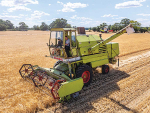
Fifty Eight years ago, on the 16th of August 1968, August Claas, the founder of the harvesting company and father of Helmut Claas, personally presented a Claas Senator combine harvester to Scottish farmer John Steven.
Case IH has unveiled its redesigned next generation Puma Series tractors, said to offer improvements in connectivity, operator comfort, fuel efficiency and drivability.
Founded in Cologne, Germany, in 1864, Deutz AG is the world’s oldest engine company, with its engines and systems used in construction equipment, agricultural machinery, material handling equipment, such as forklift and telehandlers, as well as stationary equipment such as gen-sets.
Founded in Cologne, Germany, in 1864, Deutz AG is the world’s oldest engine company, with its engines and systems used in construction equipment, agricultural machinery, material handling equipment, such as forklift and telehandlers, as well as stationary equipment such as gen-sets.



Testing confirms H5 bird flu in a single northern giant petrel, found dead on a remote Cape Palliser beach in the Wairarapa, says Dr Mary van Andel, the Ministry for Primary Industries' (MPI) Chief Veterinary Officer.

"What's for dinner?" may sound like a simple question, but for many Kiwi parents, answering it has become a job in itself.
Fifty Eight years ago, on the 16th of August 1968, August Claas, the founder of the harvesting company and father of Helmut Claas, personally presented a Claas Senator combine harvester to Scottish farmer John Steven.
New Zealand consumers are paying more for beef mince than ever before, with the average retail price now sitting above $24 per kilogram, according to Rabobank.
State farmer Pamu has delivered its strongest operating result on record.
Four years since it was first detected in New Zealand, researchers and growers now know much more about management of maize pest fall armyworm (FAW).