Massey Ferguson Unveils New Tractors at Fieldays
Long-term exhibitor at Fieldays, AGCO and its Massey Ferguson brand, have several new products on display.
 increase font size
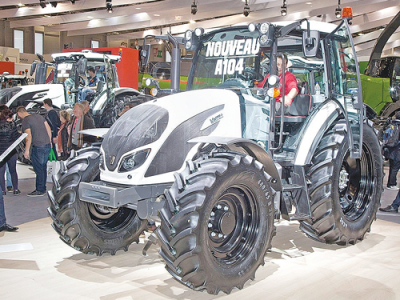 Valtra A series.
The new fourth generation Valtra A series tractor appears to have piggybacked on sister company Massey Ferguson’s 4700, 5700 and 6700 series.
Whilst MF tractors for European distribution are made at Beauvais in France, the Valtra are built in Suolahti, Finland or Mogi das Cruzes, Brazil.
The global nature of the product sees chassis designated S, M or L with wheelbases of 2250mm, 2430mm or 2500mm and tare weights of 3500, 4000 or 4500kg respectively.
S versions get the AGCO Power 3.3L 3-cylinder engine in a choice of 75, 85 or 95hp; M uses the 4.0L, 4-cylinder producing 100 or 110hp; and the L tops out at 120 or 130hp.
Models over 100hp are Tier 4 emission compliant with an SCR-only solution to keep things clean and green.
All ranges get a 40km/h, 12 forward/12 reverse speed transmission, delivered by six main speeds and two ranges, with no power shifts at this stage, but likely to appear in the future.
A choice of mechanical or power shuttle is complemented by an optional creep set than can get minimum speeds right down to 90m/hour at 1400rpm.
At the business end, lift capacities are 3000, 4300 and 5200kg respectively for the S, M and L variants, with open centre gear pumps delivering 65L/min on the S, and 98L/min on the M and L versions. Tractors can be specified with up to three sets of rear remote valves.
The operator gets a six-post cabin with a sweeping A-post pillar and sloping hood to give good forward visibility, and the option of a hi-viz roof for loading operations.
Long-term exhibitor at Fieldays, AGCO and its Massey Ferguson brand, have several new products on display.

Given that current diesel pricing is a bit like a ride on a fairground roller coaster, it should be no surprise to hear that manufacturers are looking for alternatives.
Massey Ferguson has announced the release of the SB.1436DB small square baler to New Zealand, featuring a unique layout producing two rows of bales during each pass, doubling output over a single baler producing 14-by-18-inch bales.
With the rapid rise of diesel prices since the start of the Iran conflict, farmers and growers are taking fuel consumption seriously as their bottom line is being eroded.
Since its official release to the New Zealand market in July 2025, the Massey Ferguson 5M Series has steadily solidified its position.


Farmgate lamb prices are down by 8%, beef cattle by 4.5% and farm expenditure up by 4.2%.
Kiwifruit growers are watchful but remain optimistic as concerns around the potential effects of the El Niño weather pattern this season.
Almond hulls sourced from Australian orchards may have the potential to help New Zealand cows reduce emissions, boost milk yield and lower input costs.
Striking a balance between meeting the needs of industry to speed up approval time for products but on the other hand ensuring that risks are properly assessed.
Surprised, humbled and quite thrilled. That’s the reaction of James Allen, one of the founding partners and now chief executive of AgFirst, on being made a life member of the Institute of Rural Professionals.