Krone XDisc 710 Now Fits John Deere, New Holland Foragers
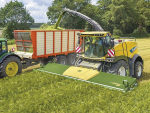
Krone's XDisc 710 direct-cut header can now be used by John Deere and New Holland forage harvesters, as well as the Krone Big X it was originally designed for.
 increase font size
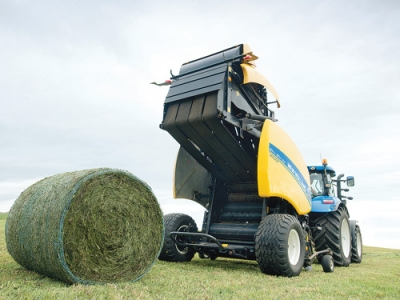 New Holland clearly knows how to produce variable chamber balers.
New Holland clearly knows how to produce variable chamber balers: it has at least 235,000 machines worldwide.
Its new Roll-Belt series replaces the BR 7000 series, from which experience it claims capacity increases up to 20% and bales with density higher by around 5%.
The Roll-Belt 150 and 180 models have 1.5 and 1.8m maximum bale diameters respectively, and can be supplied with the standard SuperFeed or CropCutter rotors.
Up front the 2.3m pick-up area is completely re-designed, using five solid tine bars carrying reinforced rubber tines said to be 10% stiffer laterally; they last up to five times longer and help increase working capacity by up to 20%.
At the rear of the pickup a new feed assist roller clears the area and merges the crop centrally to match the width of the bale chamber. Users can specify the non-chopping SuperFeed rotor with a 455mm diameter and 'W' shaped feeder fingers or the 15 knife CropCutter variant for fine chopped bales.
New to the Roll-Belt series is a drop down floor under the rotor area which allows the clearance of any blockages from the tractor seat so baling can continue unhindered.
The variable bale chamber is made up of four belts 273mm wide, which create a large contact area for optimal bale formation. The absence of belt joiners precludes stretching and ensures good bale shape, and the belt surface is self-cleaning in difficult conditions.
Bale density has been increased by adding a second hydraulic density control cylinder, which results in up to 5% greater density than the previous series machines.
All models are supplied net-only as standard, though they can also add twine to increase versatility. The twine feed system has been improved to include a twin feed layout said to help maintain bale shape, and CropCutter models now have a repositioned net feed for faster cycle times; the machines can carry two spares rolls of net.
Control of the machine is ISOBUS compatible which should allow fingertip control of set-up, operation and bale count management.
Completing the new look are single-piece side panels which are locked for safety, but open wide for easy access and maintenance. A power cut-off switch fitted to the drawbar allows shut-down of the baler's electrical system to ensure safe net change or maintenance.
Krone's XDisc 710 direct-cut header can now be used by John Deere and New Holland forage harvesters, as well as the Krone Big X it was originally designed for.
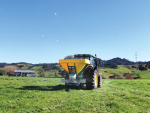
Kiwi built to suit Kiwi conditions, the Fieldays reveal of its new 3-point linkage mounted e-Spreader will add another string to Hamilton-based SAM Machinery’s already extensive portfolio of fertiliser spreading tools.
Creating a great deal of enthusiasm at Agritechnica, the T5.120 ‘Il Trattore’ styling concept tractor was celebrating the legacy of research and development, engineering, and design expertise, with the concept bearing a striking green and red colouring and styling inspired by the original first Fiat tractor, the Fiat 702 and the ‘Made in Italy’ logo.
First unveiled in 2023, New Holland has announced the addition of the T7.270 Methane Power CNG (Compressed Natural Gas) tractor to the recently expanded T7 Range.
A group of eight Giltrap Agrizone customers travelled to Europe in July with managing director Andrew Giltrap, taking the opportunity to visit St Valentin, Austria, to see New Holland tractors being built.


Pāmu has released its FY26 Integrated Annual Report, reporting a Net Operating Profit of $113 million, more than double the $49 million recorded in FY25.

Meat Industry Association data, released alongside the Red Meat Sector conference in Wellington, shows export value climbing across the US, China, UK and Canada.
Applications are set to open for the 2027 Zanda McDonald Award, a trans-Tasman award recognised for identifying and fast-tracking talented young leaders in agriculture and agribusiness.
The Royal New Zealand College of General Practitioners (the College) and Hauora Taiwhenua Rural Health Network are calling for investment in a proposed new training pathway for rural GPs, warning that many rural practices are struggling to recruit while a large share of the existing workforce nears retirement.
Federated Farmers has called on Central Otago District Council (CODC) to drop or vote down a plan to truck sludge from Alexandra and Cromwell to farmland near Lauder, warning it would compound an "outrageous" situation created by a separate council's decision weeks earlier.
Synlait has swung to second-half profit as operations stabilise, but the dairy processor still posted a $75.4m annual loss.