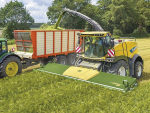
Krone XDisc 710 Now Fits John Deere, New Holland Foragers
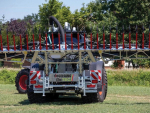
Krone's XDisc 710 direct-cut header can now be used by John Deere and New Holland forage harvesters, as well as the Krone Big X it was originally designed for.
 increase font size
 New Holland super feed
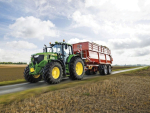
FORTY YEARS of making its Roll-Belt balers, and sales of 235,000 machines, is prompting manufacturer New Holland to affix a ’40-year’ decal to a new variant of this globally popular machine, the company says.
The latest generation Roll-Belt is said to “redefine” round baling, with technology that can improve capacity by 20% and density by 5%.
New Holland introduced the Roll-Belt variable chamber baler series in 2013, with customised feeding systems like the SuperFeed and CropCutter rotor options. The new ActiveSweep crop processing solution also offers “tailored” baling.
Now new Roll-Belt variable-chamber round balers are replacing the BR7000 series, with 20% greater capacity. Many features will enhance productivity, the company says.
“The Roll-Belt baler enables operations to specify the baler that suits their needs,” says Greg Moore, New Holland hay and harvest product specialist. “The standard rotor SuperFeed and professional CropCutter variants enable tailored baling.
“The all new pick-up, dual density system and endless belt design will deliver significant productivity gains.”
The pick-up is redesigned to boost capacity by up to 20% in silage. Buyers can choose between 1.8m and 2m configurations. The standard heavy-duty, five solid tine bar pick-up with reinforced rubber tines – 10% stiffer laterally and lasting five times longer – maintain pick-up performance in difficult, uneven and stony terrain, says the maker.
The new standard feed-assist roll transfers the crop from the pick-up to the rotor while simultaneously merging the flow of the crop to ensure it matches the exact width of the bale chamber.
The folding castoring gauge wheels make changing from transport to field configuration simpler. The wheels swing up and round, and are locked in the transport position without having to be removed.
The SuperFeed standard 455mm rotor, with New Holland’s ‘W’ pattern fingers, maintains high throughput of all crops. The CropCutter variant delivers the densest bales, with 15 integrated knives for fine chopping.
The maker’s DropFloor function is designed as a time-saver to be operated from the cab. When large wedges of crop block the rotor, the floor is lowered to provide more space in the feeding zone and baling can continue.
The Roll-Belt baler has four 273mm wide belts which prevent losses and improve tracking performance. The increased belt stability ensures a large contact area with the crop to improve reliability and bale formation. Endless belt technology ensures the belts are strong as there are no joints. This eliminates stretching for uniform bale formation. And the belts’ texture makes cleaning easier.
New Holland is imported in New Zealand by C B Norwood Distributors Ltd.
Tel. 06 356 4920
Krone's XDisc 710 direct-cut header can now be used by John Deere and New Holland forage harvesters, as well as the Krone Big X it was originally designed for.
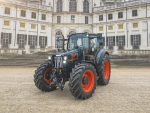
Creating a great deal of enthusiasm at Agritechnica, the T5.120 ‘Il Trattore’ styling concept tractor was celebrating the legacy of research and development, engineering, and design expertise, with the concept bearing a striking green and red colouring and styling inspired by the original first Fiat tractor, the Fiat 702 and the ‘Made in Italy’ logo.
First unveiled in 2023, New Holland has announced the addition of the T7.270 Methane Power CNG (Compressed Natural Gas) tractor to the recently expanded T7 Range.
A group of eight Giltrap Agrizone customers travelled to Europe in July with managing director Andrew Giltrap, taking the opportunity to visit St Valentin, Austria, to see New Holland tractors being built.
Showcased with a T7.245 at the recent National Fieldays, New Holland has expanded its T7 tractor range offering in New Zealand with the launch of a new Tier 3 long-wheelbase configuration, aimed at users looking for a reliable, no-fuss workhorse.


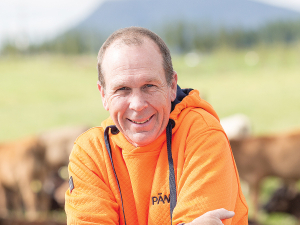
Pāmu has released its FY26 Integrated Annual Report, reporting a Net Operating Profit of $113 million, more than double the $49 million recorded in FY25.

Meat Industry Association data, released alongside the Red Meat Sector conference in Wellington, shows export value climbing across the US, China, UK and Canada.
Applications are set to open for the 2027 Zanda McDonald Award, a trans-Tasman award recognised for identifying and fast-tracking talented young leaders in agriculture and agribusiness.
The Royal New Zealand College of General Practitioners (the College) and Hauora Taiwhenua Rural Health Network are calling for investment in a proposed new training pathway for rural GPs, warning that many rural practices are struggling to recruit while a large share of the existing workforce nears retirement.
Federated Farmers has called on Central Otago District Council (CODC) to drop or vote down a plan to truck sludge from Alexandra and Cromwell to farmland near Lauder, warning it would compound an "outrageous" situation created by a separate council's decision weeks earlier.
Synlait has swung to second-half profit as operations stabilise, but the dairy processor still posted a $75.4m annual loss.