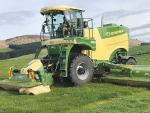
Big M triple mower cuts the mustard and much, much more
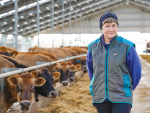
Walling Contracting’s Ben Walling describes his Krone Big M 450 self-propelled mower as a “brilliant machine”.
 increase font size
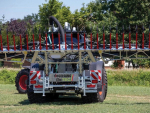
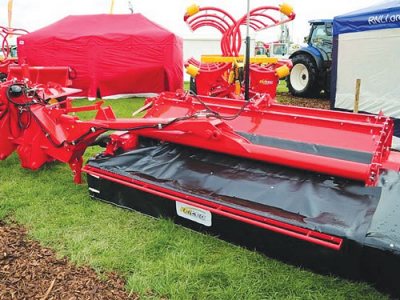 Keltec Butterfly mowers.
In a market crowded with rear butterfly-style mowers it’s no surprise to see entrants looking for a slice of the overall pie.
Irish company Keltec is well-known for its shear grab that slices upwards through a bale, allowing the material to fall while the bale wrap and netting is held at the top for easy disposal.
The company’s new twin rear mower system has both conditioner and grouping elements, with a layout that keeps weight close to the rear of the tractor that is said to reduce comparative weights by 150 - 200kg against competitors.
The compact design is achieved with a transfer system after the conditioning element that uses augers, rather than the more conventional solution of belt conveyors that tend to impart heavy weight.
The screw-type auger design is not new but has been avoided by other manufacturers due to a perception that augers ‘twist’ rather than layer the crop in the swath. This is said to create difficulties in crop feed into following machines, particularly balers or forage harvesters. Keltec claims to have addressed this problem by directing the post-conditioner grass flow over the top of the grouping augers rather than underneath the units.
The conditioning element has heavy-duty, v-shaped steel tines, said to be more aggressive on the crop and ultimately reducing the wilting period.
For large crops where grouping is not required, a deflector plate is installed allowing grass to bypass the auger units and return to the ground.
Walling Contracting’s Ben Walling describes his Krone Big M 450 self-propelled mower as a “brilliant machine”.
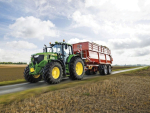
John Deere has updated and expanded its mower conditioner line-up for 2021.
Third-generation dairy farmers Hayden and Tania Edmeades run 500 dairy cows and associated young stock over 190ha near Putararu in the Waikato.
Bede Ryan Contracting has found success with the new Krone EasyCut B950 Collect mower.
A new EasyCut B950 butterfly mower from German manufacturer Krone looks to have hit the mark with users.



National’s much-touted free trade deal with India featured in the Rural Issues Debate at Mystery Creek, Hamilton on Wednesday night.

New Zealand's 2026-27 freshwater fishing season has opened, with anglers encouraged to head to rivers and lakes over the coming days as conditions look favourable across much of the country.
Central Otago District Council (CODC) has voted against a plan to spread treated sewage sludge from Cromwell and Alexandra on farmland near Lauder, a decision Federated Farmers says reflects strong opposition from rural residents.
Pāmu has released its FY26 Integrated Annual Report, reporting a Net Operating Profit of $113 million, more than double the $49 million recorded in FY25.
Meat Industry Association data, released alongside the Red Meat Sector conference in Wellington, shows export value climbing across the US, China, UK and Canada.
Applications are set to open for the 2027 Zanda McDonald Award, a trans-Tasman award recognised for identifying and fast-tracking talented young leaders in agriculture and agribusiness.