Editorial: Punching Above Our Weight
OPINION: With 10,500 dairy farms, New Zealand continues to punch above its weight around the world.
 increase font size
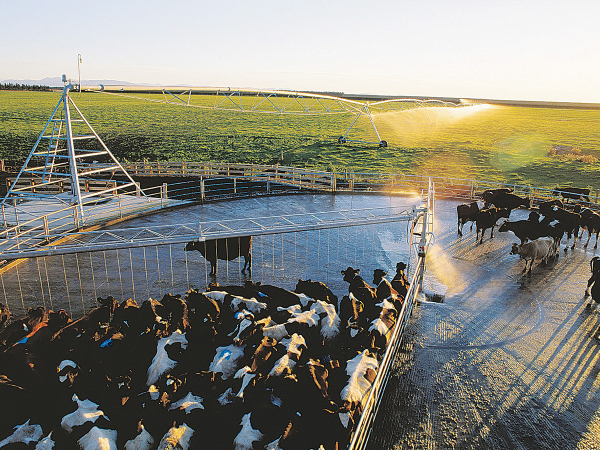 NZ milk production experienced a record May, jumping 8% year-on-year.
Dairy prices have fallen to three-year lows thanks to strong supply and weak demand, mainly for whole milk powder (WMP) from China.
Last week's Global Dairy Trade (GDT) auction saw prices drop across the board, with butter and skim milk powder recording slumps of 10% and 6% respectively. WMP price was down 0.4% to US$3,149/MT.
ASB economist Nat Keall notes that dairy prices are back to three-year lows on the back of three factors: a lack of strong demand from China for milk powder imports, weaker dairy demand in most other parts of the world, and comparatively better-supplied market than last season.
"Not much has changed of late to dissuade us of our long-held conservative view on dairy prices," says Keall.
He says the bank's below-market $7.25/kgMS milk price forecast has rested on three legs, all of which are still in play.
"For the last six months or so, GDT prices have largely travelled in line with, or perhaps even slightly below, our forecast track.
"Of note, China continues to be largely absent from recent auctions. 'North Asia' took just 15% of the WMP sold at this auction, which by our count looks to be its lowest proportion in nearly a decade.
"As we've noted in earlier reports, Chinese WMP production remains strong at the same moment that domestic consumption is still soft."
With recent Chinese economic data underperforming, Keall isn't envisaging a big change to this story on the demand side here.
"Additionaly monetary stimulus has been signalled, but nothing dramatic, and with consumer confidence weak, there's a risk that households simply horde cash in the event of interest rate cuts.
"For now, Southeast Asia is helping prop up demand, though the economic outlook isn't rosy there either. And finally, broad strength in the USD continues to make things tricky for many dairy importers."
 |
|---|
|
ASB economist Nat Keall. |
The supply-side story is much the same too. European production closes its peak period with decent year-on-year growth. NZ production experienced a record May with milk production jumping 8% year-on-year and while climate indicators are looking mixed for later in the season, output starts with a bit of momentum behind it, notes Keall.
"Softer WMP prices for contracts two and three suggest that buyers are feeling comfortable with the supply outlook for NZ's peak production months."
A weaker New Zealand dollar future may offer some respite.
Keall says Fonterra will end up with a more favourable exchange rate than anticipated when the season began, but that's comparatively small fry compared with the underlying weakness in prices.
"What's more, there will be progressively less scope for further weakness in the Kiwi to lift our forecast as the season wears on."
Westpac economist Paul Clark notes that last week's GDT results does little in terms of setting the direction for prices over coming months.
"For now, still soft global dairy demand and soft global dairy production are weighing on prices," says Clark.
"That said, an expected rebound in Chinese demand later in the year will hopefully provide some price support."
Westpac is forecasting a milk price of $8.90/kgMS for the season.
OPINION: With 10,500 dairy farms, New Zealand continues to punch above its weight around the world.
A milk glut around the world shows no sign of easing, putting downward pressure on farmgate milk prices for the next few months.
Fonterra has reduced its forecast 2026/27 Farmgate Milk Price.
New Zealand dairy farmers are set to be the first in the world to receive access to a new digital physical milk pricing tool that enables them to fix the price for their physical milk.
RaboResearch senior analyst Emma Higgins expects the 2026/27 dairy season to be another profitable one.



OPINION: In politics, credibility is and should be big. It must surely rank higher than charisma, which is quite trite and superficial. Yet, voters nowadays are often wooed and influenced by how someone looks or talks at a superficial level. TV plays a huge role in this.

Farmers can spend less time on paperwork, thanks to a new data sharing agreement between DairyNZ’s DairyBase and LIC’s MINDA software.
Kaikōura families affected by July's severe storm have found a practical solution to a problem that's kept some children away from regular schooling for weeks: a washed-out section of Inland Kaikōura Road, which has stopped the local school bus from running its usual route.
Rural New Zealand is welcoming the Government’s recent package of rural healthcare initiatives.
Interest in agritech and production animal systems has prompted Massey University's School of Agriculture and the Environment to new majors to its popular animal science degree.
Ballance Agrinutrients chief executive Kelvin Wickham says despite a tough year, he is pleased the business has returned to profit.