Co-existence with genetic modification 'possible'
Co-existence of genetically modified (GM) and non-GM plants in New Zealand industries will be challenging, but is achievable, a review has found.
 increase font size
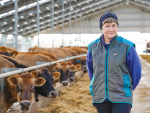
 Dr John Caradus, Grasslanz Technology
Developing pasture species that enable farm animals to produce less biogenic methane and nitrous oxide is a critical tool in NZ's quest to reduce greenhouse gas emissions (GHGs).
John Caradus who is chief technology officer for Grasslanz Technology and someone who has spent a lifetime in plant breeding says the best starting point to reduce GHG emissions in New Zealand is at the pasture level and looking at what the animals eat.
Much research is already underway in this area at Grasslanz, which is now part of the Bioeconomy Science Institute, in collaboration with other organisations both in NZ and offshore.
He says the two predominant pasture species grown on NZ farms are perennial ryegrass and white clover, but notes that there are other species that could be used such as tall, meadow fescue, cocksfoot and a number of minor legumes.
"But one of the problems with some of the other pasture legumes is that they don't compete well in our grazed swards. So, if we could find a way of getting a legume such as Lotus corniculatus, also known as birds-foot trefoil, into our grazed pastures that would make a difference," he says.
Caradus says birdsfoot trefoil can produce condensed tannin of the appropriate type and amount in its leaves.
He adds that if we could integrate these types of species into our perennial ryegrass sward it would aid in reducing methane production and probably nitrous oxide too.
The idea of mixed species is one that is being closely researched and trialled at present.
For example, Massey University and others are looking at what difference plantain, chicory and white clover can have on reducing GHG emissions.
There is also work going on in the field of genetics to produce animals with low methane emitting traits.
While new research is taking place, much of this can be traced back to work done by agricultural scientists in the 1970s.
Caradus believes this was due to the funding regime at the time when scientists had more control over their research than now, whereby the funder - by default the Government - sets very tight limits on what research can be done.
However, under the new funding system that is about to get underway, there is hope that science funding will be better aligned with farmers' needs.
"However, the reality is that today, in terms of pasture development and management, we are still relying heavily on the work done by the scientists in the 1970s," says Caradus.
While scientists can develop new grass species that reduce methane and nitrous emissions in animals, success at a farm level depends on how the pasture is managed, says John Caradus.
He says high stocking rates - particularly on dairy farms - is not conducive to pasture persistence and therefore the gains available in grasses cannot be realised.
"Pasture persistance is a real issue. This is because of the impact of droughts and insect pests. Even with fungal endophytes in ryegrass which protect the plant from insects. It's that combination plus overgrazing that can drive down the persistance of our ryegrass pastures," he says.
Caradus says it's a matter of getting farmers to back off a little on grazing pressure.
Developing new methane reducing legumes is not easy he says because our major species of ryegrass and tall fescue grass don't have the secondary metabolites that will reduce GHG emissions. One option for this he says might be to use gene editing or genetic modification.
For Caradus and the teams of scientists working to develop new grass species it is encouraging that in general New Zealand farmers are willing to try new opportunities and can be regarded as early adopters.
He says this became evident when a new endophyte strain of ryegrass - AR1 which protects the plant from Argentine stem level and reduces ryegrass staggers - was introduced in the early 2000s.
Co-existence of genetically modified (GM) and non-GM plants in New Zealand industries will be challenging, but is achievable, a review has found.

The Government's plan to merge the seven crown institutes presents exciting possibilities for plant technology company Grasslanz Technology, says chief executive Megan Skiffington.


The Royal New Zealand College of General Practitioners (the College) and Hauora Taiwhenua Rural Health Network are calling for investment in a proposed new training pathway for rural GPs, warning that many rural practices are struggling to recruit while a large share of the existing workforce nears retirement.
Federated Farmers has called on Central Otago District Council (CODC) to drop or vote down a plan to truck sludge from Alexandra and Cromwell to farmland near Lauder, warning it would compound an "outrageous" situation created by a separate council's decision weeks earlier.
Synlait has swung to second-half profit as operations stabilise, but the dairy processor still posted a $75.4m annual loss.
LIC shareholders have elected a new North Island representative to the co-operative's Board, along with five representatives to its Shareholder Reference Group (SRG), following the company's Annual Meeting held in Invercargill.
Farmers across parts of Southland and South Otago are continuing to deal with difficult conditions after a prolonged run of wet weather, with pressure building around feed supply, stock management, pasture damage, farm infrastructure and everyday workloads.
Federated Farmers says it welcomes Labour's commitment to reviewing the Sharemilking Agreements Act, calling on other major parties to do the same.