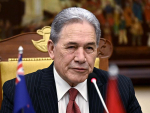
Winston Peters' FTA attacks 'just dog whistling' - Jacobi
International trade expert Stephen Jacobi says Winston Peters' objections to the Indian free trade deal are "ridiculous".
 increase font size
 Stephen Jacobi.
Agreement by 15 participants in the Regional Comprehensive Economic Partnership (RCEP) trade negotiations marks an important milestone.
So says New Zealand International Business Forum (NZIBF) executive director Stephen Jacobi.
The text has been agreed by all but India which reportedly has sought to have New Zealand dairy excluded and is also concerned about a flood of cheap goods from China.
Jacobi says business leaders are naturally disappointed that India is not yet ready to sign on and there is also more work to do on the market access front to secure the final deal.
“From the outset, NZIBF has viewed the RCEP as a means to provide important impetus to broader trade liberalisation efforts, even though New Zealand has FTAs with most of the participants,” said Jacobi.
“The inclusion of India provided an opportunity to remove trade barriers and expand trade and investment with an important partner with whom we do not have an FTA. The strategic and commercial benefits of RCEP will be increased should India ultimately join, but the agreement as it stands is of significance in a world where such agreements are becoming rare.
“Without knowing the final market access package it is difficult to judge the overall value of the deal, but we remain hopeful that, along with improved trade rules, the RCEP will provide for new, commercially meaningful access on key products of export interest, including to India.”
The RCEP negotiations were launched in late 2012 comprising 16 countries including the members of ASEAN, Australia, China, India, Japan, Korea and New Zealand. Once fully implemented, it will be the world’s largest trading bloc representing 39% of global GDP, a significant share of global trade and nearly half the world’s population.
Jacobi also says New Zealand’s trade relationship with China stands to be further enhanced by the upgrade of the Free Trade Agreement (FTA) announced last week.
“The FTA has been a stand-out success in boosting trade and investment between the two countries. Inevitably further gains are harder to achieve, but as this upgrade shows, the FTA remains a vital framework for continuing to expand the relationship, particularly at a time when protectionism is on the rise around the world.”
International trade expert Stephen Jacobi says Winston Peters' objections to the Indian free trade deal are "ridiculous".

Leading trade analyst Stephen Jacobi has rubbished claims that New Zealand could have got a better free trade deal with India if it had prolonged the negotiations.
New Zealand’s top business leaders are urging the US Administration to review “unjustified and discriminatory tariffs” imposed on Kiwi exporters.
The recent squabble between the Cook Islands and NZ over their deal with China has added a new element of tension in the relationship between China and NZ.
The world is now amid potentially one of the most disruptive periods in world trade for a very long time.



National’s much-touted free trade deal with India featured in the Rural Issues Debate at Mystery Creek, Hamilton on Wednesday night.

New Zealand's 2026-27 freshwater fishing season has opened, with anglers encouraged to head to rivers and lakes over the coming days as conditions look favourable across much of the country.
Central Otago District Council (CODC) has voted against a plan to spread treated sewage sludge from Cromwell and Alexandra on farmland near Lauder, a decision Federated Farmers says reflects strong opposition from rural residents.
Pāmu has released its FY26 Integrated Annual Report, reporting a Net Operating Profit of $113 million, more than double the $49 million recorded in FY25.
Meat Industry Association data, released alongside the Red Meat Sector conference in Wellington, shows export value climbing across the US, China, UK and Canada.
Applications are set to open for the 2027 Zanda McDonald Award, a trans-Tasman award recognised for identifying and fast-tracking talented young leaders in agriculture and agribusiness.