Fonterra Elections 2026: Voting Opens Tuesday 20 October
Fonterra shareholders can begin voting on Tuesday 20 October in the 2026 Board of Directors’ election, a Co-operative Council election in one Ward, and seven Annual Meeting resolutions.
 increase font size
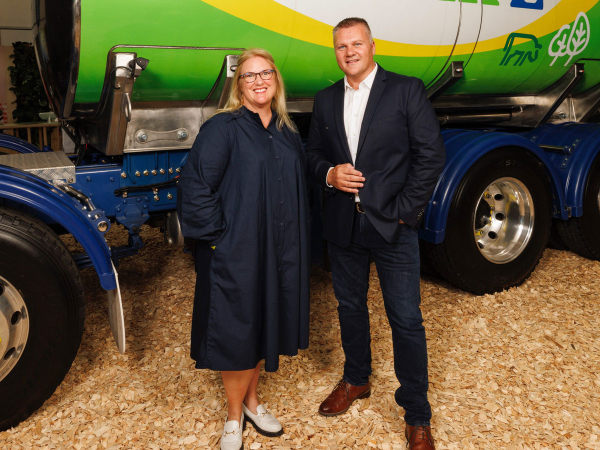 Fonterra chief executive Miles Hurrell (right) and Nestle New Zealand chief executive Jennifer Chappell in 2023.
Fonterra has announced new financial incentives for farmers who achieve on-farm emissions targets.
Beginning with the 2025-26 season, Fonterra says it will introduce a top-up payment for farms that achieve certain emissions criteria as part of its Cooperative Difference framework as part of an agreement with its two major global customers – Mars and Nestle.
Currently, a total of 10c/kgMS has been possible across all achievements within the Co-operative Difference framework. The new Emissions Excellence achievement will offer a further payment of between 1-5c/kgMS for farms that meet the criteria.
Based on last season’s data, it is estimated that approximately 5,000 farms will be eligible for the payment next season.
Meanwhile, new incentives that benefit farmers will be funded through separate agreements with Mars and Nestlé, who have been working with the co-operative to make progress towards their individual sustainability goals by supporting farmers to reduce emissions.
The funding will be split between on-farm solutions and an Emissions Incentive payment.
Farmers who achieve the Cooperative Difference will be eligible for access to on-farm tools for services designed to further improve emissions efficiency, for example herd efficiency from LIC and CRV. Based on last season's figures, 87% of Fonterra farmers will be eligible for the on-farm solutions.
To be eligible for the 10-25c/kgMS Emissions Incentive payment, a farmer would need to achieve the Co-operative Difference and have one of the lowest emissions footprints in the co-operative. Based on last season’s data, this would apply to between 300 and 350 farms next season.
Over the past few years, both Mars and Nestlé have independently supported Fonterra farmers with their sustainability actions through several initiatives.
Last year, Fonterra farmers were invited to take part in the Mars Tools and Services pilot, which provided access to tools and services, including animal efficiency services and digital tools.
Additionally, Mars previously supported the Greener Choices programme, designed to make it easier for Fonterra farmers to identify and buy products at Farm Source that could help them make sustainability improvements on-farm.
In 2022, Fonterra and Nestlé announced a partnership that included the Net Zero Pilot Dairy Farm in Taranaki, designed to help reduce on-farm emissions.
In 2023, Fonterra announced that Nestlé would make an additional payment of between one and two cents per kgMS for farms that achieved any level of the Co-operative Difference. From next season, that payment will be replaced with the new Emissions Incentive payment.
Miles Hurrell, chief executive of Fonterra, says the new incentives demonstrate the co-operative’s strategy in action.
He says the co-operative is growing relationships with customers who value the work farmers put into producing milk, along with Fonterra’s on-farm data.
“This helps us make progress towards achieving our on-farm emissions target and deliver the highest returns for our farmer shareholders’ milk,” Hurrell says.
“Last year we confirmed six strategic choices that we believe will help grow further value in the years ahead and this is an example of how we’re delivering on two of those choices, deliver the strongest farmer offering and build on our sustainability position,” he says.
Chief R&D, procurement and sustainability officer for Mars Snacking, Amanda Davies says that between new equipment and technology, embracing more sustainable practices comes with a price tag for farmers.
“That’s why we’re working with partners like Fonterra to help remove this barrier – providing cash, tools, and technology to support farmers in making meaningful, long-term changes,” she says.
Nestlé New Zealand chief executive, Jennifer Chappell, says globally is a significant purchaser of New Zealand dairy ingredients, and dairy remains its largest source of greenhouse gas emissions.
“As we strive towards achieving net zero emissions by 2050, we are committed to reducing our Scope 3 emissions,” Chappell says.
“We will continue to support farmers, in partnership with Fonterra, fostering new economic opportunities and helping them lower their greenhouse gas emissions.”
Fonterra shareholders can begin voting on Tuesday 20 October in the 2026 Board of Directors’ election, a Co-operative Council election in one Ward, and seven Annual Meeting resolutions.

Fonterra Co-operative Group chief financial officer Andrew Murray has resigned to take up a role outside the dairy giant.
Four candidates have been confirmed for two director positions on Fonterra’s board.
A record farmgate milk price and strong global demand is laying the foundation for continued growth of organic dairy farming in New Zealand.
Waikato milk processor Tatua has again declared a record milk payout to farmer shareholders, leaving other processors in the dust.



Federated Farmers has welcomed new rural policies released by ACT, saying they align closely with its own election priorities.

Rural Contractors NZ says proposed changes to land transport rules for agricultural vehicles are a welcome response by the Government to out of date regulations which have seen members hit with huge fines.
Alliance is calling for final applications for its 2027 Graduate Programme, with applications closing on Sunday 25 October.
Decades piloting planes has ensured vet and farmer David Hayes is focused on safety. So, after a serious accident while welding on farm, he is sharing his experience so others can learn from it.
Canterbury milk processor, Synlait Milk has confirmed Leon Fung as its chief executive officer.
OPINION: Making it easier to collect rainwater and use it to grow crops and livestock is a no brainer.