Rearing facilities should be set up and maintained well to ensure calves stay healthy.
Young calves should be housed for at least four weeks to ensure they stay warm and are using their energy for growth.
Housing
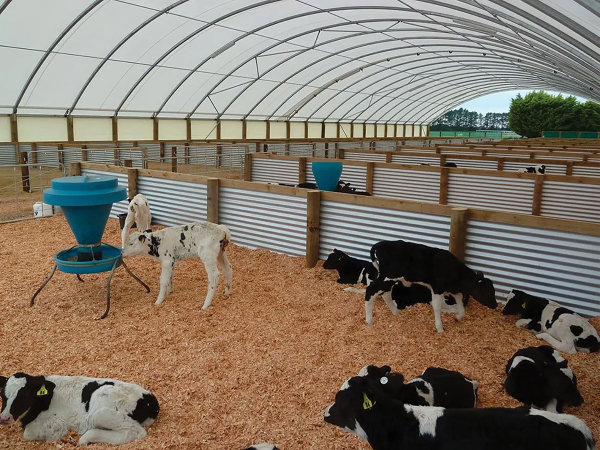
- Must be dry and draught-free for calves to regulate body temperature. Calves should be protected from wind and rain in a structure twice as long as wide.
- Cover the floor surface with dry materials such as sawdust, shavings, straw, post peelings or wood chip to a depth of at least 200-300mm. Avoid dusty materials and the use of river stones.
- Ideally, the floor should be lower at the front to help drain effluent and water. Regularly muck out and top up bedding so it is clean and dry.
- Good ventilation is essential and is best situated where the walls meet the ceiling. It's easier to ventilate across the shed, not down the length. Ventilation should be adaptable, so the use of boards, shutters or wind cloth is recommended.
Spacing Calves
- Calves are less stressed and have higher intakes in smaller groups. The shelter should provide a minimum of 1.5m2 per calf and, where possible, minimise calf contact between pens. The best approach is 10-20 calves per pen.
- Depending on how many calves you are rearing - having more than one shed separated into pens allows for easier separation of age groups and feeding levels. Having more pens also provides a safety barrier between calves in case of a disease outbreak and will allow a pen/shed to be rested for cleaning and sanitation between different batches of calves.
Feeding Facilities
- Each pen must have clean, quality water, which should be checked, cleaned and refreshed daily. In hot conditions, restricted feeding systems, high meal/fibre intakes or scours, an additional 2-6l of water per calf per day is required.
- Meal troughs should have sufficient space for feeding at least half of the calves at the trough at any one time. Provide a minimum of 300mm of trough space per calf.
- Keep meal feeders free from moisture and clean weekly to avoid fungal growth.
- Keep milk lines as short as possible and ensure there is no stale milk left in hoses between feeds.
Cleaning
- Ensure all feeding equipment is regularly cleaned and treated with disinfectant. Bottles or cafeterias should be cleaned between feeds and automatic feeders (mixing bowls, lines and teats) should be cleaned and calibrated at least weekly.
- Use a broom to remove any excess material in laneways. Do not use a high-pressure hose inside the shed, as this will aerosol bacteria and viruses to calves in other pens.
- Spray the rearing area, feeding utensils and teats with approved virucidal at least once a week and daily during a disease outbreak.
- Rodents and birds must be controlled.
- Isolate sick calves to reduce risk of spreading disease.
Post-Colostrum Feed
Following the colostrum period, calves should be fed clean whole milk from the vat or a good quality calf milk replacer (CMR). Fortunately, research has shown that calves can thrive on a good-quality CMR.
- Start initial feeding two hours after arrival with warm milk or electrolytes.
- Consider a quality probiotic to help calves transition to their new environment.
- Check teat quality (replace if damaged) and quantity - there should be spare teats on each feeder, e.g. eight calves to a 10-teat feeder.
- Clean the feed equipment and teats after each feeding.
- Check for slow-drinking calves that struggle to compete within the group. If necessary, re-group calves on drinking speed and vigour.
- Check milk temperature. Feeding warm (38-40°C) is recommended.
- Clean, fresh water must be available ad-lib from day one.
- Calves should be fed at the same time each day.
- Offer a good-quality forage source (e.g. chopped grass hay, pasture, chopped silage), plus a grain-based starter, from week 1. The solid feed offered should be tailored to suit the rearing system selected. Calves can be reared successfully on high levels of milk (e.g. 8L/day) plus good-quality forage.