Paris Agreement Exit Could Put NZ-EU and UK Trade Deals at Risk
Politicians calling for New Zealand to withdraw from the Paris Agreement on climate risk damaging two of our gold-plated free trade deals.
 increase font size
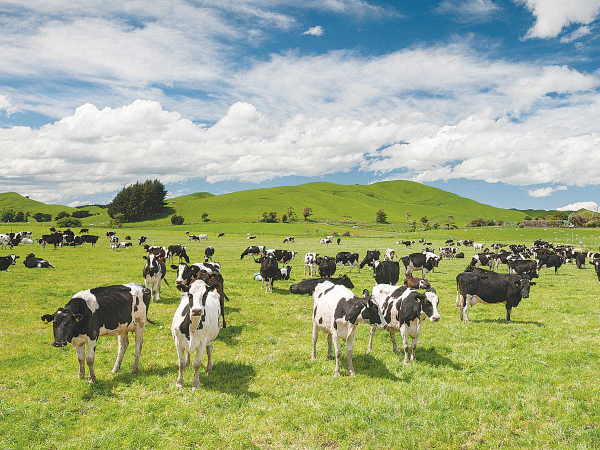 Some farming leaders in the dairy and sheep & beef sectors argue that NZ should not have signed the deal.
OPINION: Since the announcement of the trade agreement between NZ and the EU there has been considerable outcry.
Some farming leaders in the dairy and sheep & beef sectors argue that NZ should not have signed the deal, but soldiered on to get a better one. Fair comment perhaps, but remember there are other primary sector people - notably those in the horticulture sector - who are smiling at the outcome.
To the critics, maybe it's time to take a look at the history books and understand why the EU, or EEC as it was originally known, was created. Put simply, it was to provide food sovereignty or food securityin the economic union.
This was based on the problems that surfaced at the end of WWII when ordindary people - not those in concentration camps - starved to death. The figure of 45,000 in the Netherlands is one that comes to mind.
There was also an element in the EEC charter of creating political stability in Europe and using trade as a conduit for this.
So, as we have learned, sport and politics are inseparable and so is trade and politics - to suppose otherwise is naïve. Hence in the end, it was the politicians who made the final call to accept the EU's offer.
This NZ/EU FTA is a reflection of history. What we saw in the negotiations was a position taken by the EU that differed little in theory from when we first began negotiating with it back in 1973. While NZ is seen as a friend, it is not a blood relation and, as they say, 'charity begins at home'.
The EU has always prioritised its own electorally important farmers over countries like ours, who would like the largest possible slice of their affluent market.
Sure, the deal is not perfect and no one thought it would be as good as the UK FTA. But we do have a deal and an enshrined political relationship with one of the powerhouse economic regions in the world.
When Britain joined the EU, we had to find alternative markets and were very succesful in doing so. It is arguably much harder today with Covid and a very uncertain and somewhat frightening geopolitical situation. But people have to eat and we produce some of the best food in the world in a sustainable way, so there is hope.
The time has come to accept what we have got and move on as we have always done.
Politicians calling for New Zealand to withdraw from the Paris Agreement on climate risk damaging two of our gold-plated free trade deals.
The European Union ramped up its presence at this year's Fieldays.
The stark realities of the world trade that New Zealand is having to face have been revealed by Trade Minister Todd McClay.
New Zealand and the European Union are closer than ever.
New Zealand exports to the European Union have surged by $3 billion in two years under the New Zealand-European Union Free Trade Agreement.
New Zealand dairy farmers are set to be the first in the world to receive access to a new digital physical milk pricing tool that enables them to fix the price for their physical milk.
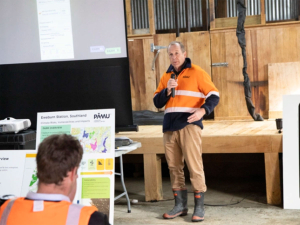
State farmer Pāmu is opening its farm gates this summer in an effort to give the rural sector the opportunity to see how large-scale, multi-system farming is delivering productivity and profitability across New Zealand.
A five-year study has found that the cost of reducing emissions without technology may be significant and unsustainable for Northland dairy farmers.
DairyNZ says Waikato farmers need certainty on Plan Change 1, but they say that certainty must be matched with practical, workable rules and a clear transition that doesn't get ahead of the new resource management system currently under review.
While the Government has moved quickly to make commercial hauliers' lot easier during the current fuel crisis, they appear to be stuck in the creep box when it comes to the agricultural industry.
Waikato farmers have been told that the Government’s new planning system legislation and the region’s Plan Change 1 (PC1) “won’t mesh together very well”.