Strip-till offers major savings
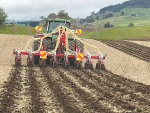
The Fookes family farm at Korakonui, just south-east of Te Awamutu in the Waikato.
 increase font size
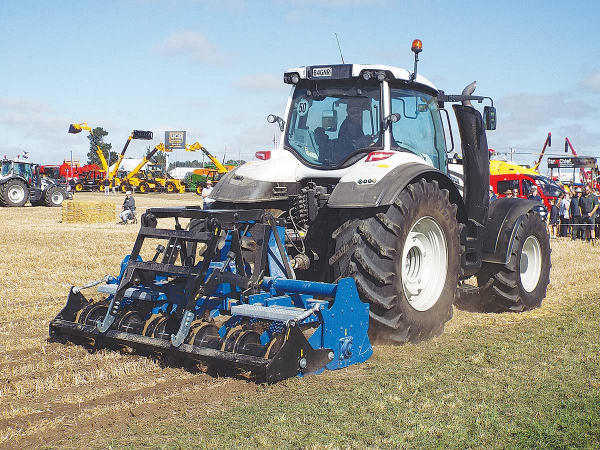 Tulloch Farm Machines offers the Strebel SAG 16 Strip Tillage System for establishing maize and fodder beet crops.
With farmers and contractors looking to reduce crop establishment costs, the arrival of increasingly accurate GPS and a range of specialised implements, may make 'recreational' cultivation a thing of the past.
Experts suggest that excessive cultivation is damaging soil structure, often bringing poor sub-soils up into the growing levels.
There is also the impact caused by loss of moisture and fine soils to the wind. Add to that the cost of our cultivator metal and high fuel costs, then new techniques are sure to be adopted in the coming years?
Strip Tilling is a technique that allows minimal soil disturbance, reducing cultivation costs by only cultivating a narrow band of soil where the crop is going to be established. It leaves the ground between rows unmoved and brings land back into production much more quickly.
Masterton-based importer and distributor Tulloch Farm Machines offers the Strebel SAG 16 Strip Tillage System, aimed at establishing maize and fodder beet crops throughout New Zealand.
The machine that takes the outward form of a rotary cultivator, but underneath, the traditional rotor is replaced by a unit that carries a series of "milling units" that only cultivate a band of ground where the crop is to be established.
With an overall width of 3m, the machine can be configured to prepare four rows at 75cm or six rows at 50cm spacing. Ahead of each of the rows is a subsoiler leg that can operate at depths of up to 25cm. This breaks up any plough pan, before passing soil to the rotor, which can operate to 15cm working depth for breaking down into a finer seedbed.
Rear of the milling heads, an infinitely adjustable packer system sees sectional units behind each of the four or six rotors. These reconsolidate the ground, leaving a level surface for subsequent operations. The lateral extremities of the main rotor housing feature extended side panels to create a definitive edge for the worked strips.
Manufactured using Hardox steel for durability and an extended working life, power input is 1,000rpm. It has a cam-clutch overload protection set-up, with a 4-speed main gearbox and gear-driven, lateral oil bath drive to the main rotor. Speed adjustment via the main gearbox allows operators to quickly adjust rotor speeds to ground conditions or required forward speed.
As an option, a Cat2/3 rear three-point linkage can be used to carry a precision planted. Or the installation of a front-mounted hopper can be specified to incorporate fertiliser into the prepared tillage strip ahead of the rotor.
The Fookes family farm at Korakonui, just south-east of Te Awamutu in the Waikato.


Waikato milk processor Tatua has again declared a record milk payout to farmer shareholders, leaving other processors in the dust.

A Labour-led Government won’t be bringing back the controversial freshwater rules of 2020.
National’s much-touted free trade deal with India featured in the Rural Issues Debate at Mystery Creek, Hamilton on Wednesday night.
New Zealand's 2026-27 freshwater fishing season has opened, with anglers encouraged to head to rivers and lakes over the coming days as conditions look favourable across much of the country.
Central Otago District Council (CODC) has voted against a plan to spread treated sewage sludge from Cromwell and Alexandra on farmland near Lauder, a decision Federated Farmers says reflects strong opposition from rural residents.
Pāmu has released its FY26 Integrated Annual Report, reporting a Net Operating Profit of $113 million, more than double the $49 million recorded in FY25.