Election 2026: How Parties Would Lift the Arable Sector
As part of its Election 2026 coverage, Rural News asked political parties how they would help pull the arable sector out of the doldrums. Here's what they said:
 increase font size
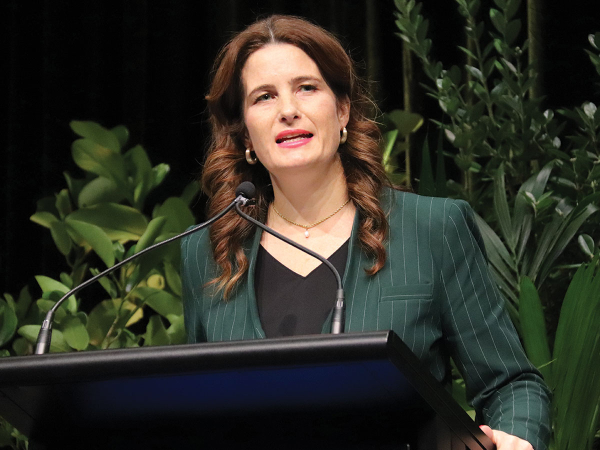 Finance Minister Nicola Willis addresses the HortNZ Conference.
Trade Minister Todd McClay says his officials plan to meet their US counterparts every month from now on to better understand how the 15% tariff issue there will play out, and try and get some certainty there for our exporters about the future.
McClay recently returned from the US where he met with his counterpart in the Trump administration to try and get a clearer picture on the tariffs. He says the biggest harm being done to exporters is the uncertainty. He says he and his officials are trying to find out what might happen if NZ comes to a point where the balance of trade between the two countries is equal or in America's favour.
Speaking at the HortNZ conference in Wellington recently, McClay told delegates he wants to know if the 15% tariff will be cut when the trade balance is restored. He says at present, for example, $10 worth of kiwifruit that is hit by the 15% tariff will cost 50 cents more. The worry is at what point the tariffs end up affecting sales.
"The message I am getting from their officials is we are the good guys; they don't have us in their sights and don't have an issue with us. But, unfortunately, the president has made a decision," he says.
McClay told the conference that the horticulture sector produces an exceptional product which people all around the world want to eat and he praised the innovation that is taking place in the sector.
"Innovation is the key to everything we do in the primary sector, and you in horticulture typify that. People all around the world are trying to make it harder for us to get access to their market for many reasons, including protecting their own production, and we need to be the best," he says.
McClay talked up the benefits of recent FTAs with the EU and UK and most recently the NZ UAE trade agreement which just came into effect. He says this latest deal will open the door to one of the world's fastest growing economies and deliver an estimated annual $42 million in tariff savings.
McClay says negotiations of an FTA with India are progressing well and says they are now about 60% complete. But he cautioned that the hard issues were still to be negotiated.
"We are going to fight for everything we can and while it may not be perfect, it will be much better than what we have now. And I can tell you now that the deal will be done before the next election."
Celebrate Success
Finance Minister Nicola Willis says horticulture doesn't do enough to celebrate its success.
Speaking at the recent HortNZ Conference, she told those present that the sector has a lot to be proud of - including the quality of the products it sells and its rapid rise as an export earner.
"Your sector is very important to the economic growth of the country and exemplifies the Government's economic vision. You are high value, export driven and have untapped potential and a powerhouse in our economy, not only in terms of the export dollars you earn, but also contributing to the employment of thousands of people in our regions," she says.
Willis says when she is overseas and sees NZ produce, she feels a sense of pride. On the home front, she enjoys visiting orchards and commercial growing operations, seeing packhouses and talking to marketers. Willis says the Government's aim is to further unlock the potential of the sector by listening to the needs of its many parts.
As part of its Election 2026 coverage, Rural News asked political parties how they would help pull the arable sector out of the doldrums. Here's what they said:
Food and fibre exports have returned a billion- dollar bonus to the country.
The Government is backing work on a community-led water storage scheme that could irrigate up to 11,000 more hectares of the Poverty Bay flats, Agriculture Minister Todd McClay says.
A Labour-led Government won’t be bringing back the controversial freshwater rules of 2020.
It was billed as a chance for all the political parties to woo the rural vote, but question marks hang over just how effective this was.



Federated Farmers has welcomed new rural policies released by ACT, saying they align closely with its own election priorities.

Rural Contractors NZ says proposed changes to land transport rules for agricultural vehicles are a welcome response by the Government to out of date regulations which have seen members hit with huge fines.
Alliance is calling for final applications for its 2027 Graduate Programme, with applications closing on Sunday 25 October.
Decades piloting planes has ensured vet and farmer David Hayes is focused on safety. So, after a serious accident while welding on farm, he is sharing his experience so others can learn from it.
Canterbury milk processor, Synlait Milk has confirmed Leon Fung as its chief executive officer.
OPINION: Making it easier to collect rainwater and use it to grow crops and livestock is a no brainer.