
NZ Food Safety Boss on Balancing Speed and Risk in Approvals
Striking a balance between meeting the needs of industry to speed up approval time for products but on the other hand ensuring that risks are properly assessed.
 increase font size
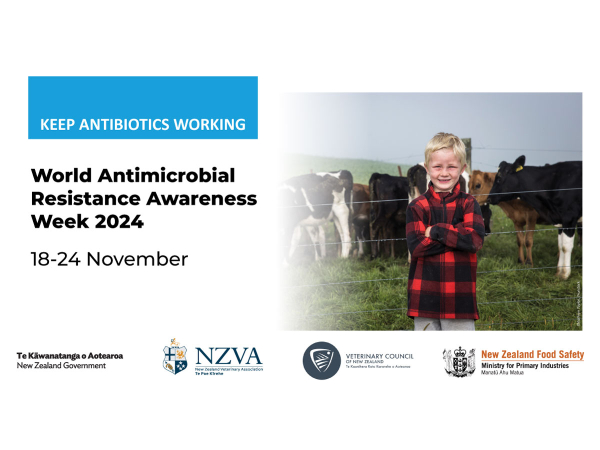 World antimicrobial resistance (AMR) Awareness Week begins today.
World antimicrobial resistance (AMR) Awareness Week begins today, and New Zealand Food Safety (NZFS) says you too can do your part.
“AMR or antimicrobial resistance is a global health and development threat, with the World Health Organization declaring that AMR is one of the top 10 global public health threats facing humanity,” says NZFS deputy director-general Vincent Arbuckle.
“AMR is what happens when germs develop the ability to resist the medicines designed to kill them, which can happen due to misuse and overuse of antimicrobials. So, the more we can reduce our use of antibiotics, the more effective they will remain for us for generations to come.”
To help tackle this challenge, NZFS works with the veterinary and primary industry sectors to promote careful use of antibiotics and encourage infection-prevention strategies, such as good hygiene and vaccination.
“We undertake a range of surveillance and monitoring activities, which include auditing the sectors and the sale of antibiotics. The most recent report shows that sale of antibiotics used in animals and plants is down for the sixth year running,” says Arbuckle.
“That’s an encouraging sign, but there is more to do, and it will take a co-ordinated effort to reduce the threat. As part of this, we work closely with Ministry of Health and international regulators in an effort to manage AMR.”
This year, NZFS published the New Zealand Animal and Plant Sectors' AMR Implementation Plan to underpin joint work being undertaken to implement a refreshed National AMR strategy.
“While the use of veterinary antibiotics in NZ is low compared with other countries, the continued vigilance of veterinarians, farmers and other industry stakeholders, as well as our ongoing monitoring and support, are all vital to minimise the incidence of AMR,” says Arbuckle.
If you have pets, or animals on a lifestyle block or farm, there are things you can do to join the fight against AMR:
This year’s theme for World AMR Awareness Week is: “Educate. Advocate. Act Now.”
“We’re all in this together, so we will keep educating and advocating – and we hope you will help us ‘act now’,” says Arbuckle.
Striking a balance between meeting the needs of industry to speed up approval time for products but on the other hand ensuring that risks are properly assessed.

New Zealand Food Safety (NZFS) is reminding New Zealanders to keep food safety top of mind as they head into the festive season.
New Zealand Food Safety (NZFS) says it is supporting importer Goodfood Group in its decision to recall Food Snob and Mon Ami brand French Brie and Camembert cheeses.
An Auckland man who illegally killed and sold pigs and a chicken has been fined $8,000.
An Auckland woman has been fined $25,245 and an Auckland man has been ordered to do 300 hours of community service for the illegal slaughter and sales of pigs.


Federated Farmers has called on Central Otago District Council (CODC) to drop or vote down a plan to truck sludge from Alexandra and Cromwell to farmland near Lauder, warning it would compound an "outrageous" situation created by a separate council's decision weeks earlier.

Synlait has swung to second-half profit as operations stabilise, but the dairy processor still posted a $75.4m annual loss.
LIC shareholders have elected a new North Island representative to the co-operative's Board, along with five representatives to its Shareholder Reference Group (SRG), following the company's Annual Meeting held in Invercargill.
Farmers across parts of Southland and South Otago are continuing to deal with difficult conditions after a prolonged run of wet weather, with pressure building around feed supply, stock management, pasture damage, farm infrastructure and everyday workloads.
Federated Farmers says it welcomes Labour's commitment to reviewing the Sharemilking Agreements Act, calling on other major parties to do the same.
For Canterbury dairy farmers Sian Meijer and Rick Wobben, wearable technology has become one of their most valuable on-farm tools - helping manage 1850 cows across an expansive, high-performing dairy operation while improving efficiency, mating outcomes and day-to-day decision making.