
Lanaco and Blueair Launch World-First NZ Wool Air Filter
New Zealand wool is reaching new heights as air filtration companies move away from synthetic products to biodegradable alternatives.
 increase font size
 Wool Source chief executive Tom Hooper with Agriculture Minister Damien O'Connor.
A new initiative targeting new products and markets for NZ strong wool - with export applications as diverse as cosmetics and printing - has recently been launched.
Wool Source, a subsidiary of Wool Research Organisation of New Zealand (WRONZ), aims to develop the new products and assess market demand for the strong wool innovation. This follows the completion of its pilot production facility at Lincoln to manufacture its first deconstructed wool ingredients from 100% New Zealand strong wool.
The three-year programme aims to prove the commercial viability of the new deconstructed wool particle products. The goal is to develop more sustainable product ingredient alternatives for global manufacturers and consumers - while revitalising New Zealand's strong wool sector, creating new value for our economy and communities.
"By funding fundamental and enabling science that creates new uses and products from our traditional wool clip, we aim to create better outcomes for farmers with increased demand and pricing at the farm gate," WRONZ chair Andy Fox says.
The Ministry for Primary Industries (MPI) is contributing $1.95 million via its Sustainable Food and Fibre Futures (SFF Futures) fund, alongside $2.92 million from WRONZ. Meanwhile, wool sector body the Strong Wool Action Group (SWAG) is also jointly funding Wool Source's market engagement alongside WRONZ.
"New Zealand's wool production, 90% of which is a strong wool, is at a low point with declining sheep numbers," SWAG chief executive Andy Caughey says. "With many farmers selling wool at a net cost this season, the industry is desperately seeking innovation to boost strong wool demand and prices."
Wool Source chief executive Tom Hooper says the company is reimagining the future of New Zealand wool.
"Our new pigment, particle and powder products - from all-natural, sustainable, strong wool particles - provide the base ingredient for a new generation of high-performance manterials, free from chemicals, metals, and toxins," he told Rural News.
"We're focusing on proving the commercial viability of our products and establishing demand, predominantly with international markets. To do this, we need to demonstrate we can produce at scale, with a unit production cost and price point that enables margins that create long term value-added opportunities for the New Zealand wool sector."
One of these potential deconstructed products from wool is keratin, a protein that is used in things like shampoo and other cosmetics. Hooper told Rural News the wool-sourced keratin was far more sustainable than other sources of keratin protein that are extracted in "less than ideal environmentally friendly" ways.
However, he concedes that there is a "big difference" between expressions of interest and commercial viability. The aim for Wool Source is to find commercially viable markets for its products and then prove there is a viable business.
"From there, we will look to partner with someone to build a new, NZ-based manufacturing plant," Hooper adds.
"For wool prices to increase and get to sustainable level for NZ growers we need to find new products and new markets for NZ wool and that is what we are all about."
About Wool Source
Wool Source is a wholly-owned subsidiary of Wool Research Organisation of New Zealand Inc (WRONZ). Its focus is the commercial development of WRONZ's New Uses for Strong Wool programme. The company is taking the deconstructed wool products created from this research project - including particles, powders and pigments - and testing them in a pilot manufacturing facility, as well as determining their commercial viability.
New Zealand wool is reaching new heights as air filtration companies move away from synthetic products to biodegradable alternatives.

Will a stronger, more coordinated voice help rebuild confidence and improve returns in the wool sector?
OPINION: Confidence in the wool sector is rebounding as prices hit levels not seen in more than 15 years.
The recently signed free trade agreement with India is an invitation to strengthen relationships between the New Zealand and Indian strong wool industries, says Wool Impact chief executive Andy Caughey.
Strong competition and tightening supply have seen wool reach its highest prices paid at auction since 2011.


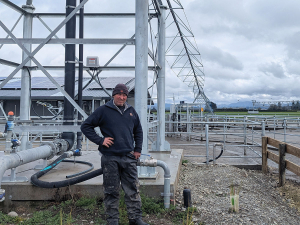
Converting a longstanding cropping farm to dairy was the only way to ensure the land stayed in the family long term, says new dairy farmer Rod May.

As the election heats up, Organics Aotearoa New Zealand (OANZ) has launched its election scorecard designed to help voters wanting to support policies that grow organic and New Zealand's organic sector.
A 'tsunami' of milk from key exporting countries is winding down and this may be good news for New Zealand dairy farmers.
Will the good times last? That's one of the key issues to come out of the latest Federated Farmers confidence survey.
Outgoing Fonterra Co-operative Council chair John Stevenson says that it has been a privilege to represent the co-op's farmer shareholders.
Have a plan in place for your cows and staff.