Massey Uses Portable Analyser to Measure Pasture Soil GHGs
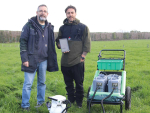
Researchers at Massey University are using a special piece of scientific equipment to improve the measurement of greenhouse gas emissions from pasture soils.
 increase font size
 James Millner is leading research into the potential benefits of planting native shrubs for use as sheep fodder.
Multiple potential benefits from planting native shrubs for use as sheep fodder are being researched as part of the Hill Country Futures Programme.
The project, led by Dr James Millner, Academic Dean - Agriculture, at Massey University, was launched in 2019. It currently has three trial sites for a range of native shrubs, looking at palatability, digestibility, protein content and other nutritional charactersistics as well as the Mātauranga Māori (Māori knowledge) for a range of species.
Hill Country Futures is a long-term $8.1m programme focused on future proofing the profitability, sustainabiity and wellbeing of New Zealand's hill country farmers, their farm systems, the environment and rural communities.
Overall, the research focuses include improving animal productivity, animal welfare, biodiversity and soil health, while mitigating soil eroision and climate change.
Millner says the programme is assessing the productivity and seasonal growth patterns of indigenous species potentially useful as occasional 'browse species'.
These are Houhere (Hoheria populnea), Pāpāuma (Griselinia liteoralis), Karo (Pittosporum crassifolium), Karamū (Coprosma robusta), Whauwhaupaku (Pseudopanax arboreus), Māhoe (Melicytus ramiforus) and Taupata (Coprosma repens).
The non-native Salix Kinuyanagi, a browse willow, has been included and can be compared with the natives.
"Culturally, native shrub species have long histories and the team is building that knowledge into this project," he explains.
"We are interested in giving hill country farmers as many options as possible and are specifically looking at the potential of native shrubs as forage in hill country."
Millner says farmers with steep erosion-prone land may be interested in getting it into woody vegetation.
"Pinus radiata is one option commonly used but not everyone wants to be a forester. Transport and harvesting in steep areas is also expensive so it may not be economically feasible," he says.
"There are potential economic benefits to planting native shrubs, along with enhanced diversity, improved water quality and reduced erosion. We are looking at the additional potential benefits for forage and for grazing sheep around the shrubs."
The native shrubs selected are known to be heavily browsed in areas where there are deer and goats, suggesting they would be palatable to sheep.
"We are also looking into nutritional traits," Millner adds.
"For instance, the protein content and any tanins that can affect how protein is digested, and if there are any anthelmintic - natural anti-parasite - qualities, as there is evidence some shrubs have that effect."
The research is also looking at what happens during in vitro digestion to see how much methane and CO2 is produced in the rumen.
Currently, the project has three hill country trial sites on farms, two in the Manawatu and one on the Mahia Peninsula.
"We have discovered that the foliage of the shrubs is pretty digestible and we don't think there will be any problem with sheep browsing on it," Millner says.
"It is a bit low in protein, so not good for long-term feed or for young animals that farmers are needing to grow quickly, but there would be no problem at all with short-term maintenance feeding.
"In summer, it could provide a short-term food resource to fall back on when dry and shelter, particularly after shearing - alongside the environmental and economic benefits."
He adds that research into anthelmintic work is due to start soon. Food preference trials are due to get started in the autumn and full feeding trials in spring 2022. That will be followed by feeding trials.
"The sheep food preference trials will involve us offering standard feeds like lucerne chaff as well as leaves from the shrubs to see if the sheep will voluntarily eat them," Millner says.
"We'll take data from that as the basis for a proper feeding trial and measure dry matter in and dry matter out. Ultimately, we want to grow some shrubs in paddocks with sheep, however this will be subject to approval by an animal ethics committee."
Millner believes the main disincentive to planting hill country with native shrubs would be the cost - at $4-$5 per shrub, plus the cost of planting out and initial weed control. This would need to be weighed against the potential benefits, including income carbon credits.
"The initial outlay can be >$10,000/ha - limiting widespread uptake unless assistance from central or regional government was available," he explains.
"Our aim is to provide robust information that can give farmers, their bankers and others the information they need to have confidence that it is a good thing to do, so they can weigh up the cost and the benefits."
Researchers at Massey University are using a special piece of scientific equipment to improve the measurement of greenhouse gas emissions from pasture soils.

Interest in agritech and production animal systems has prompted Massey University's School of Agriculture and the Environment to new majors to its popular animal science degree.
The industry is crying out for graduates with agricultural related degrees.
A four year trial has reaffirmed that mixing plantain into dairy pastures can help reduce nitrogen losses to freshwater while maintaining milk production and profitability, say researchers.
Special courses for secondary school teachers to help excite kids about agriculture and horticulture are now being run at Massey University.


Safer Farms is urging farmers to make sure everyone working on farm has safe, suitable footwear for the job.

The Government is backing work on a community-led water storage scheme that could irrigate up to 11,000 more hectares of the Poverty Bay flats, Agriculture Minister Todd McClay says.
Agri-tech company Herd-i has become a new all-region sponsor of the New Zealand Dairy Industry Awards (NZDIA), the largest nationwide celebration of excellence in the dairy sector.
Four candidates have been confirmed for two director positions on Fonterra’s board.
Returning to the family dairy farm after playing 20 years of professional rugby around the world is no easy task.
After delivering another record farmgate milk price to 100 supplying farms, independent milk processor Tatua is entering thee new financial year with a positive outlook.