DairyNZ Resilient Pastures Trial Expands Across North Island
Farms across the upper North Island are trialling different pasture mixes as part of a research programme that aims to build greater resilience into farming systems.
 increase font size
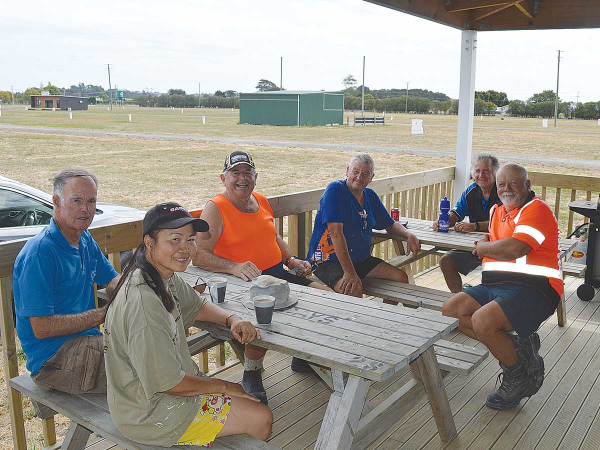 Northland field days committee members (from left) Ross Newlove, Gail Cole, Basil Cole, Shane Hanley, Ned Stevens and John Phillips take a well-earned break from marking out the Dargaville showgrounds site late last month.
The biggest issue facing organisers of next month’s Northland Field Days is water, says vice president Basil Cole.
He says normally roads and tracks at the Dargaville site are watered regularly during the event to minimise dust pollution.
However, with Northland facing a severe drought and water restrictions in place, organisers are making alternative arrangements for water to keep dust away during the three-day event.
“It’s one of the driest we’ve had for a while,” Cole told Rural News.
“We are connected to the town water supply…normally we would have no problems watering the roads at the site but not this year.
“Everyone is facing water restrictions: while there is no problem with drinking water we won’t be able to use the town supply to douse our roads.”
Cole says organisers are making arrangements to cart water to the site to keep dust at a minimum.
He says big trucks, with engine fans, operating within the site create huge dust.
Despite the big dry and water restrictions, preparations for the event are in full swing.
Last week, Cole and his group of committee members were marking the site.
About 400 exhibitors have booked sites: only a handful of sites remain for sale.
The committee members are volunteers, mostly farmers, growers and semi-retired professionals.
Cole, an engineer, is semi-retired.
He says the event is a big part of their calendar year for the volunteers.
“It takes up a good three months of our lives every year but we enjoy it,” he says.
“There are dairy farmers here who volunteer during the day then go off to their farms to milk cows in the afternoon.”
The Northland Field Days kick off on Thursday March 5.
Gates open for visitors at 9am daily: on Thursday and Friday, gates will close 4.30pm and 3.30pm on Saturday. Entry is restricted from an hour before closing time each day.
Tickets can be purchased either at the booths or online: $12 for an adult, $5/child (5yrs – 16 yrs), $30/family (2 adults plus up to 3 children that are 5-16yrs old). Under 5’s are free.
No dogs are allowed at the Northland Field Days unless the dog is an authorised assistance dog such as a guide dog or the dog has been authorised, in writing, by the Northland Field Days to be on an exhibitor site.
Parking for the event is across the road from the main gate. Cole says tractor trailers will be available for people to travel from the car park to the site.
He says despite the drought, organisers are hoping for a great event.
Northland Field Days
❱❱ March 5-7
❱❱ At Dargaville showgrounds
❱❱ Over 400 exhibitors
❱❱ Tickets - $12/adult, $5/child, under 5 - free
Farms across the upper North Island are trialling different pasture mixes as part of a research programme that aims to build greater resilience into farming systems.
OPINION: Since when did one and one make three? Who didn't smell an elephant-sized rat when our leaders decided to give $60 million to save the cement factory in Northland?
New Zealand needs to make sure that it continues to focus on its own food security, according to HortNZ board member and blueberry grower Dermott Malley.
A five-year study has found that the cost of reducing emissions without technology may be significant and unsustainable for Northland dairy farmers.
After its flagship 1200 model set a Guiness World Record in forage harvesting, mopping up 4096 tonnes of whole crop silage in 12 hours, Claas has picked up a brace of awards from the American Society of Agricultural and Biological Engineering (ASABE).



Federated Farmers has welcomed new rural policies released by ACT, saying they align closely with its own election priorities.

Rural Contractors NZ says proposed changes to land transport rules for agricultural vehicles are a welcome response by the Government to out of date regulations which have seen members hit with huge fines.
Alliance is calling for final applications for its 2027 Graduate Programme, with applications closing on Sunday 25 October.
Decades piloting planes has ensured vet and farmer David Hayes is focused on safety. So, after a serious accident while welding on farm, he is sharing his experience so others can learn from it.
Canterbury milk processor, Synlait Milk has confirmed Leon Fung as its chief executive officer.
OPINION: Making it easier to collect rainwater and use it to grow crops and livestock is a no brainer.




