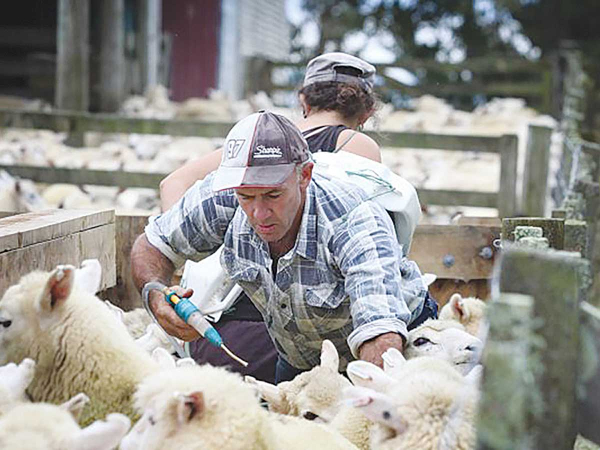
Beef + Lamb New Zealand is seeking global partnerships as it works to revolutionise internal parasite management in the face of increasingly widespread drench resistance.
On the back of a workshop organised by B+LNZ Research, the organisation has invited global cohorts to establish a collaborative partnership.
The intent is to give farmers the tools and confidence to manage internal parasites (worms) in new and sustainable ways.
The initiative is being led by Dr Cara Brosnahan and Dr Suzi Keeling – both members of B+LNZ’s Research team. The pair recognise the potential for a global partnership to maximise impact.
“This partnership will enhance innovative and varied perspectives to deliver tangible outcomes for livestock farmers at a global scale,” Keeling explains.
“The pooling of resources, funding and expertise will help realise the vision of sustainable and lasting worm management.”
Internal parasites, or worms, cost the livestock industries in New Zealand, Australia and Europe over $4 billion annually in lost production. With no new drench products being developed, farmers will no longer be able to rely on drenches as their primary worm control strategy.
Brosnahan says farmers will increasingly rely on a farm systems approach that will incorporate a range of tools and management strategies – some of which are yet-to-be developed.
She says new systems for effective and sustainable management need to be developed as soon as possible as they will take time to implement.
“Complex and innovative solutions will require collaborative approaches that integrate a number of different disciplines.”
Keeling says a cooperative network of farmers, rural professionals, animal health companies, rural service businesses and suppliers will need to be part of the solution by supporting farmers as they change the way they manage worms.
B+LNZ Research is proposing a threepronged approach to its vision of sustainable, long-term worm management.
The first is the promotion of best practice to prolong the efficacy of drench options. It says some farmers have been successful in minimising or delaying the onset of drench resistance and sharing their strategies will encourage other farmers to adopt best practice worm management.
The development of a suite of new tools is the second part of B+LNZ’s approach.
Brosnahan explains that these will be developed in partnership with groups across the livestock sector including farmers, rural professionals, research organisations and government.
These tools will cover a range of approaches such as genetics, advancements in diagnostics and therapeutic options, as well as improvements in feed management and composition, enhanced environmental management, including biocontrol and pasture treatments, and the development of models to better understand the interactions between pest, host and pasture.
The third part is the development of new systems for worm control which would bring together all available tools and knowledge.
“Because the systems don’t rely on a single point of control, the development of resistance or breakdown of control will be avoided,” Brosnahan adds. “The systems will be adaptable, giving farmers the tools to manage worms in a way that is specific to their farming situation.”