
New Rural Recycling Scheme to Replace Voluntary Farm Plastics Programmes by 2027
Environment Minister Nicola Grigg has announced details of a new rural plastics recycling scheme.
 increase font size
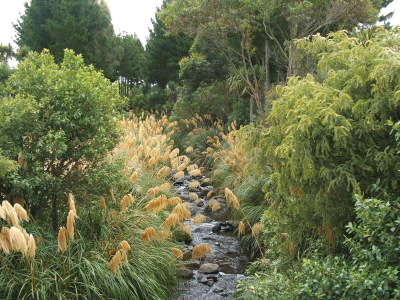 What management needs to be done to ensure riparian strips do not become overloaded and therefore useless?
Could our riparian systems become overloaded and therefore useless?
Riparian strips are correctly promoted as useful tools for reducing environmental pollution, especially for their ability to filter out faecal bacteria and sediment before these enter streams. But there is much more to it, writes Bert Quin.
Many frequently made claims for the ability of riparian strips to improve water quality are based on very short-term studies only. This is particularly true of phosphorus (P) and nitrogen (N) removal.
Unfortunately, we are now in the days of emphasis on short-term, quick-results trials that lend themselves to publication in many different journals to ensure more cash from equally short-sighted funding organisations and companies with vested interests.
In-depth studies of the longer-term change in effectiveness of riparian strips, development of optimum management plans for them and how to pay for these, are few and far between.
Instead of long-term trials of actual riparian strips, where cause and effect can be clearly assessed, we just monitor river and lake water quality. Reductions in levels are presented by fertiliser industry funded scientists as ‘proof’ that the ‘mitigations’ the authors and funders of the research are promoting are the cause of the reductions. And they are implied to be a permanent fix and supposedly safe for continuing application of high rates of the fertiliser N and soluble P.
Nothing could be further from the truth.
Entry of the ‘big four’ (ie calcium, magnesium, phosphorous and boron) into riparian strips certainly results in less loss direct into the waterways they border. But we have to keep in mind that the quantities of the ‘big four’ being released from intensively grazed pastures are massively greater – typically by one to two orders of magnitude -- than those that enter water from native vegetation.
So the two most important questions should be, what management needs to be done to ensure riparian strips do not become overloaded and therefore useless, and, who should pay for this management?
A promising sign of increasing understanding is a recent article in Dairy News (June 25), sourced from the Waikato Regional Council publication ‘The condition of rural water and soil in Waikato region’. The article repeats the WRC’s advice that riparian strips and drains must be ‘very well maintained’ to be environmentally effective, but neither get into the detail and long-term costs. But the magazine article is poorly headed ‘Plants, fencing keeps nasties out of water’. A far more relevant title would have been ‘Riparian strips and drains must be well maintained to be effective’.
The article states, “In ideal conditions, fenced grass riparian strips can reduce sediment entry to streams by 80%, dissolved P by at least 50% and nitrate-N by at least 60%”. It doesn’t define ‘ideal conditions’ or make any comment on how quickly the P and N loss reductions can diminish.
Let’s look at the effect of different losses, short and long-term, and consider the two ‘elephants in the room’ -- the continuing overuse of fertiliser N and soluble P fertilisers.
To be continued in Dairy News, August 6.
• Bert Quin is the managing director of Quin Environmentals.
Environment Minister Nicola Grigg has announced details of a new rural plastics recycling scheme.

The Ballance Farm Environment Awards are coming to the West Coast of the South Island.
There's been widespread support from the primary sector for the Government's announcement on changes to freshwater farm plans that come under the Natural Environment Bill, which is now set to replace the existing RMA.
The chair of the country's environmental regulator, the Environmental Protection Authority (EPA), says changes are already under way to improve the performance of the agency to better meet the needs of those who interface with them.
New Zealand's Emissions Trading Scheme (NZ ETS) encourages afforestation while not achieving climate goals, says a new report released by the Parliamentary Commissioner for the Environment, Simon Upton.


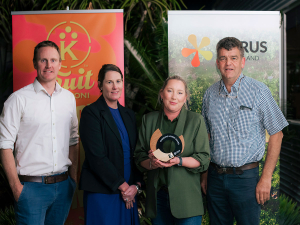
New Zealand's citrus growers were challenged to build their future on the value embedded in their fruit rather than the volume they produce, at Citrus New Zealand's annual gathering in Gisborne on 17 September.

Leading John Deere technicians and apprentices from New Zealand and Australians were recognised at the recent sixth annual JD Technician of the Year Awards, held in Brisbane.
In Dacre, near Invercargill in New Zealand’s South Island, Bruce Dinnington is running a dairy operation unlike any other.
A free online platform aggregating governance vacancies across rural and regional New Zealand has been launched.
Environment Minister Nicola Grigg has announced details of a new rural plastics recycling scheme.
Agricultural drone operators say that a government decision to allow lower-risk drone work without certification won’t lower standards but drive innovation and efficiency.