Climate-friendly cows closer
Dairy farmers are one step closer to breeding cow with lower methane emissions, offering an innovative way to reduce the nation's agricultural carbon footprint without compromising farm productivity.
 increase font size
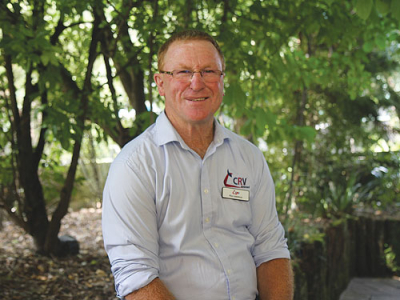 Ray Lawrence.
No one is more passionate about breeding better dairy cows than Ray Lawrence, Taranaki.
After 40 years working with local dairy farmers to breed healthier, more efficient herds, Lawrence is to retire from his field consultant and artificial insemination (AI) technician roles at CRV Ambreed.
He started at CRV Ambreed in 1976 when he trained in AI and began using the firm’s genetics in his own dairy herd. In 1983, Lawrence started working as a Stratford-Etham field consultant and in 1991 took on the broader Taranaki region as area manager.
Always passionate about helping farmers breed a healthy, long-lasting herd via pedigree bulls, he says this motivated him to stay at it a long time.
“It’s gratifying than to drive around the region each year and see the calves in the paddock that I’ve had a part in creating,” he says.
“Still, walking away from the relationships I’ve built with clients will be the hardest part of retiring.”
Lawrence applauds the new technologies that have hugely improved the industry.
“SireMatch has supported farmers to breed from good cow families and prevent issues like inbreeding and genetic defects have been a real game-changer,” he says.
“I’d like to see the wider industry herd-testing more in the future to make sure we all have access to better data and that we can improve our whole industry.”
Sales and marketing manager for CRV Oceania Mathew Macfie says Lawrence’s legacy will be visible on farms in the Taranaki region for many years.
“His knowledge of cow families and pedigrees in particular has been called on many times to help build the perfect bull team for many customers,” Macfie says.
“On the dairy farms in Taranaki, it is not hard to see the kind of cow or herd that Ray is proud to have been associated with and help build.”
The next chapter of Ray Lawrence’s life will centre on family, including wife Joyce, four children, and nine – soon to be 10 -- grandchildren.
He also plans to travel and will continue volunteer work with Lake Rotokauri Trust and the Lions club in Etham.
Although putting away his AI gloves, he won’t be letting go of his gumboots.
“After all these years I can walk away knowing that I’ve done my part. But I’ll still have my finger in farm life doing the odd bit of work on my son’s farm,” he says.
Dairy farmers are one step closer to breeding cow with lower methane emissions, offering an innovative way to reduce the nation's agricultural carbon footprint without compromising farm productivity.
CRV has produced the first homozygous polled bull to make New Zealand’s prestigious Ranking of Active Sires (RAS) list, demonstrating the strides the company is making in breeding top-quality polled bulls.
As Mycoplasma bovis (M. bovis) resurfaces in Canterbury, CRV is reassuring dairy farmers it has rigorous production processes and health testing programmes in place within its supply chain.
A Canterbury Hereford stud specialising in providing beef genetics for the dairy industry is claiming a major breakthrough in breeding for more environmentally friendly animals, with reduced urinary nitrogen emissions.
Some dairy farmers could be missing out on up to 160 kgMS of production because they are not herd testing.


LIC shareholders have elected a new North Island representative to the co-operative's Board, along with five representatives to its Shareholder Reference Group (SRG), following the company's Annual Meeting held in Invercargill.
Farmers across parts of Southland and South Otago are continuing to deal with difficult conditions after a prolonged run of wet weather, with pressure building around feed supply, stock management, pasture damage, farm infrastructure and everyday workloads.
Federated Farmers says it welcomes Labour's commitment to reviewing the Sharemilking Agreements Act, calling on other major parties to do the same.
For Canterbury dairy farmers Sian Meijer and Rick Wobben, wearable technology has become one of their most valuable on-farm tools - helping manage 1850 cows across an expansive, high-performing dairy operation while improving efficiency, mating outcomes and day-to-day decision making.
Fonterra has unveiled its annual results for the 2026 financial year, posting $27 billion in revenue and close to $20 billion returned to New Zealand farmer owners and unit holders.
The first major update to the Dairy Cattle Code of Welfare in more than a decade has been released, marking what DairyNZ describes as an important step in ensuring animal welfare standards continue to evolve alongside scientific evidence and on-farm realities.