Pāmu FY26 Report: Profit More Than Doubles to $113m
Pāmu has released its FY26 Integrated Annual Report, reporting a Net Operating Profit of $113 million, more than double the $49 million recorded in FY25.
 increase font size
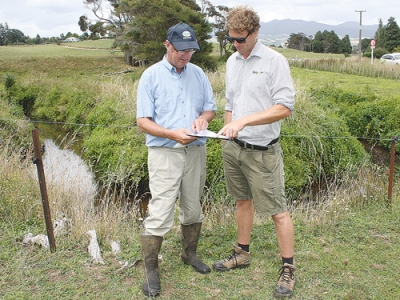 DairyNZ developer Matt Highway has been trialling the Riparian Planner with farmers. He is pictured with Waikato farmer John Bluett.
Dairy farmers in 2013 committed to the Sustainable Dairying: Water Accord which requires them to have a riparian management plan by 2020.
By 2017, they are required to exclude stock from all waterways wider then 1m and deeper than 30cm.
Now a new DairyNZ online 'Riparian Planner' provides farmers with an easy, inexpensive solution to riparian management.
The Riparian Planner enables a farmer to create an online farm-specific riparian management plan. This outlines costs, to help prioritise fencing, planting, maintenance and managing riparian zones.
DairyNZ senior developer Matt Highway is trialling the Riparian Planner with farmers.
"A riparian plan can be rolled out over a few years, so by planning now and taking a long-term approach to riparian zones farmers can budget in changing times," says Highway.
"There is a lot of pressure on farmers now but I continue to see good work by dairy farmers managing their waterways. Farmers tell me they appreciate the tool's simplicity and accuracy, and being able to work within their budget."
A plan takes no more than one hour to complete, depending on its complexity and how the riparian zone will be managed.
Having a plan should reduce the risk of planting in the wrong place, at the wrong time or spending too much.
Once completed, the plan includes costs, actions and a timeline, a plant list, a map and details on how much fencing to buy, where to plant, site preparation and pest control.
The tool's map feature makes planning easy. Simply enter the farm's supply number and zoom in on the property to mark out existing waterways including lakes, ponds, streams, rivers and drains. Select each waterway's current state by width, the area fenced off and vegetation type, then tick if it has weeds, exotics, natives or grass.
Finally, select whether each waterway is fully or partially fenced and choose what to achieve over the next one to five years, whether you plant or use grass to filter overland run-off.
As the riparian zone develops or anything changes on-farm, revisit the Riparian Planner to update details for further planning.
A riparian management plan takes pressure off the farm business and protects waterways. Riparian zones help filter out sediment and nutrients before they enter waterways, prevent land erosion and increase habitat for native wildlife.
By setting a planting plan through the Riparian Planner, management can be financially viable and done within time constraints.
The planner was developed by DairyNZ and Landcare Research, with input from regional councils and environmental experts. The project is funded through the Transforming the Dairy Value Chain Primary Growth Partnership.
• This article was first published in Inside Dairy April 2016.
Pāmu has released its FY26 Integrated Annual Report, reporting a Net Operating Profit of $113 million, more than double the $49 million recorded in FY25.
The first major update to the Dairy Cattle Code of Welfare in more than a decade has been released, marking what DairyNZ describes as an important step in ensuring animal welfare standards continue to evolve alongside scientific evidence and on-farm realities.
Have a plan in place for your cows and staff.
Environment Minister Nicola Grigg has announced details of a new rural plastics recycling scheme.
Almond hulls sourced from Australian orchards may have the potential to help New Zealand cows reduce emissions, boost milk yield and lower input costs.


High country stations, mixed sheep and beef farms, Māori-owned farms, corporates and family operations are among the nine commercial farms taking part in the Livestock Innovation Farming Transformation programme, known as LIFT.
OPINION: New health and safety guidance unveiled by the Government recently provides farmers greater certainty about what is expected of them when managing risks on farm.
The National Animal Welfare Advisory Committee (NAWAC) is seeking public feedback on proposed changes to the Code of Welfare for Rodeos.
A New Zealand initiative supporting farmers to restore the health of grazing landscapes has received international backing through the Regenerative Fund for Nature, a global collaborative fund supporting regenerative agriculture and the communities that produce natural fibres for the fashion industry.
Combine premium New Zealand products, blend in a family ritual and what do you get? A world-class functional drink.
Entries are now open across eleven regions for the 2027 New Zealand Dairy Industry Awards (NZDIA).