Boosting Crop Production by Spreading Effluent
Tararua district farmer Jamie Harris milks around 400 cows using a split calving system on his farm, Crossdale Dairies.
 increase font size
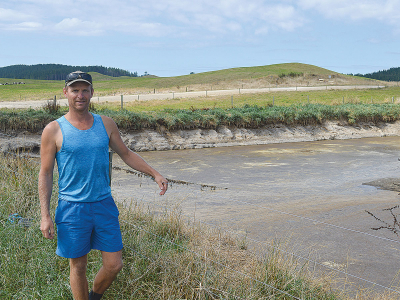 Marcel Korsten.
Tokoroa farmer Marcel Korsten operates a closed farm system: what doesn’t get out the front gate as milk has to go back onto the farm.
On his 260ha farm, Korsten hasn’t used nitrogen to fertilise paddocks for seven years; instead the whole farm is fertilised with effluent.
Milking about 670 Friesian cows and having a feedpad means a lot of nutrients are added to their diet. About 45% of feed is imported — mostly soyabean, tapioca, straw, maize sileage and some PKE.
Korten says minerals added to the cows’ diet are very valuable.
“What doesn’t go out the gate as milk is put on pastures as effluent,” he told Dairy News.
“We haven’t used fertiliser for seven years; to me, coming from the Netherlands, effluent is a real valuable resource — it’s much better than any chemical fertiliser.”
But seven years ago, Korsten’s closed farm system hit a snag; his 50m x 50m effluent pond developed a crust so bad that Korsten and his staff “could walk on it”.
Two staff had to dig for two hours just to get a pipe into the pond to suck effluent out. “It was really bad and we had to do something,” he says.
He hired a digger to remove the crust, costing $18,000; two months later the crust reappeared.
So he turned to BioMagic, having read newspaper articles about the product. He was offered Biomagic’s Impact, an organic liquid.
Korsten says he was told that typical effluent ponds are dominated by anaerobic bacteria.
“BioMagic treatment converts the pond into an aerobic state, dominated by aerobic bacteria; these bacteria digest effluent up to 12 times faster.
“For $270/month I would get microbes that actually eat crust and make the pond live; I thought ‘I haven’t got much to lose for a couple of hundred dollars’.”
But the first six months were anxious moments for Korsten.
“I nearly gave up; for six months nothing happened, then all of a sudden through the crust I could see bubbles coming.
“I was told that the bacteria were working underneath and I just couldn’t see it; I thought ‘whatever!’ ”
Korsten says the effluent pond soon turned into mudpools. “And another six months later the crust was gone and I ended up with a liquid pond.”
Korsten hires a team to spray effluent around his farm every three months.
He says there are no issues now with pumping effluent to paddocks a kilometer away in each direction; the pipes are no longer getting blocked by crusty particles.
Odour is not longer a problem and even the cows notice the difference.
Normally after crusty effluent was applied on paddocks, the cows did not eat the grass for about two weeks; now they happily graze within five days of BioMagic-treated effluent being applied to pasture.
He applies about 15ml of effluent during winter and 20ml in summer.
10L/month
Marcel Korsten uses a dosing pump to apply BioMagic Impact to effluent.
The company helped him set up a pump, which mixes the liquid with water before the shed wash.
Wash water from the milk shed and feed pad gets nicely mixed with BioMagic Imapct before entering the effluent pond.
Korsten uses about 10L of the product a month.
Tararua district farmer Jamie Harris milks around 400 cows using a split calving system on his farm, Crossdale Dairies.
Water management is an integral component of sustainable farming practices, according to Watermetrics.
Two farmers and two farming companies were recently convicted and fined a total of $108,000 for environmental offending.
A Taupiri farming company has been convicted and fined $52,500 in the Hamilton District Court for the unlawful discharge of dairy effluent into the environment.
Founded in Germany as recently as 1977, today, the Fliegl Group employs more than 1100 workers, offering an expansive range of transport solutions, from their base in Bavaria.


Most dairy regions around the country have had a pretty good season so far says Tracy Brown.
Rural leader Mark Hooper has been appointed as an independent director to the NZPork board, bringing extensive farming, governance and advocacy experience to the role.
Opportunity says its land value tax (LVT) is unlikely to force farmers into a position where asset sales or increased debt are required.
Milk powder prices are keeping farmgate prices up, helping processors offset the dip in milk fat prices.
Climate, nature and animal wellbeing make up Fonterra's refreshed sustainability roadmap released last week.
The Government is introducing a new nationwide rural recycling scheme that will significantly increase the recovery of farm plastics from March next year, Minister for the Environment Nicola Grigg announced today.