Robotic Rotary Milking: Inside a $6M Investment Paying Off Faster Than Expected
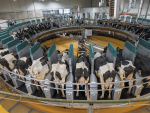
The Dairy ProQ robotic rotary, the first of its kind in the Southern Hemisphere, has proven to be an impressive addition for Victorian farmers Paul and Marsha Smith.
 increase font size
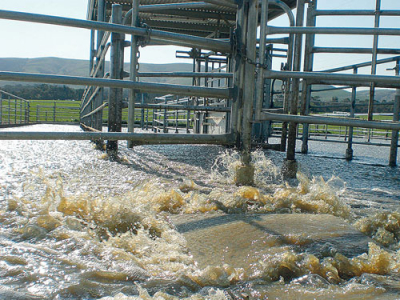 Flush valve offers quick and easy washdown.
Yard washing, pumping and effluent screening gear will be on the GEA site at the Effluent Expo at Mystery Creek. The expo will be held on November 27 and 28.
At the milking shed, the Flush Valve offers quick and easy wash-down using high volumes of fresh water or recycled effluent (‘green water’). This has a 5.5m clearing width and the liquid is delivered in a horizontal plane with little or no splashing vertically.
The heart of the system is a valve actuated via a robust airbag system for opening or closing; it requires only 40psi to achieve a head of 8m.
It’s reckoned easy to install and maintain via large access panels.
The Agri-Pump, a dual-purpose unit that agitates and pumps, can handle effluents with high fibre or solids content to supply a constant flow of well agitated material.
Using a rugged propeller knife and impellor blade system, the belt-driven unit has a pump whose revs are easily adjustable, and a rotating nozzle (optional) deals with crusts or stagnant liquid.
The unit mounts on the side of the reception pit and is supported at the base; this siting allows easy maintenance. Its 3-way gearbox drives a propeller and an impellor, to agitate and pump from a common drive shaft. The cast iron impellor carries four curved blades to pump through a 100mm outlet pipe.
In many installations the pump flow might be directed to a GEA Slope Screen that separates the liquid and solid portions of effluent, reducing wear and blockages in pumps, effluent lines and irrigator nozzles.
The liquid portion can be held in a storage tank and re-directed for wash-down, saving clean water, while the solid content can be used as a fertiliser or soil conditioner.
In operation, the Slope Screen is mounted on a platform above a solids bunker, with a flow of untreated effluent directed to the top of the screen via a regulator valve. As the effluent moves down the screen the liquid passes through to a holding tank while the solids are collected in a loading bunker.
The Dairy ProQ robotic rotary, the first of its kind in the Southern Hemisphere, has proven to be an impressive addition for Victorian farmers Paul and Marsha Smith.
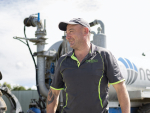
Tararua district farmer Jamie Harris milks around 400 cows using a split calving system on his farm, Crossdale Dairies.
Water management is an integral component of sustainable farming practices, according to Watermetrics.
Two farmers and two farming companies were recently convicted and fined a total of $108,000 for environmental offending.
GEA says that its latest walkover teat sprayer is helping farmers save time and boost udder health.


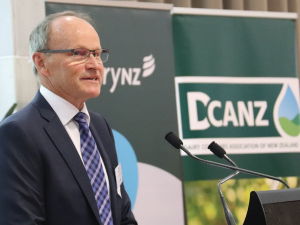
Dairy processors are ready to further boost New Zealand’s export earnings but want the incoming government to match their ambition with good policy.
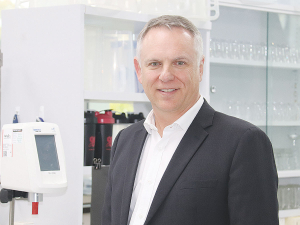
Massey University is best placed to solve the “problems” facing the dairy industry, says vice chancellor, Pierre Venter.
Synlait's longest serving employee – a man who joined the Canterbury-based milk processor even before it began processing milk – is now its newest executive.
A dairy industry leader believes eradicating the common and costly disease, Bovine Viral Diarrhoea (BVD) is within reach.
A farmgate milk price of $10/kgMS this season is firming up as milk powder prices soar and the New Zealand dollar weakens.
Federated Farmers has welcomed new rural policies released by ACT, saying they align closely with its own election priorities.