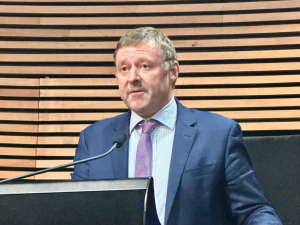
The New Zealand dairy sector has a lot of positives going for it as it sets about tackling a range of challenges globally and at home. That's the view of Ministry for Primary Industries (MPI) chief science advisor John Roche. He talked to Peter Burke about how he sees the industry coping.
John Roche by his own admission is a 'half full glass' person and is positive about NZ dealing with the myriad of challenges.
For a start he says the climate is good and the country has a strong background in innovation in the broader farming sector. From his home in Hamilton he notes he's close to where 'old' Bill Gallagher (senior) invented the electric fence and where Ron Sharp developed the first herringbone shed.
"NZ has a really strong and proud history of collaboration or what the modern people call co-innovation between farmers and scientists and that has served us extremely well. There is a challenge around climate but I think our innovation will see us through that," he says.
Roche acknowledges the effects of climate change right around the country, such as droughts in the Waikato and Southland and rain on the east and west coasts of the country. He says in the Waikato the soil is fertile and warm and with rain the landscape will look very different in a month's time.
"I don't want to play that down, it is a challenge," he says.
“These episodic rainfall events do seem to be coming more frequently. One swallow doesn’t make a summer but we have had more than one swallow in the last 12 months alone. For 12,000 years farmers have battled those climatic challenges but I am not saying that all is tickety boo because farmers and orchardists will have to adapt.
“That will involve looking at their system and looking at those points at which the climate puts pressure on the operation and then seeing how that can be managed. For some, that might mean de-intensification and for others it may mean having a feed supply available when they didn’t in the past,” he says.
According to Roche, farmers worldwide are learning to adapt to similar situations and adjust their farming systems accordingly by working out when to feed out supplements and in what quantities.
He has interacted with farmers a lot and says they want to address environmental issues, but they need solutions. He says the recent government announcement of $339 million to set up a new government- funded organisation in partnership with industry to fast track greenhouse gas (GHG) emission solutions is a great idea.
He says this is a world first and no other country has invested so much to find practical GHG tools for farmers.
Water quality is another one. Part of Roche’s job in the last 12 months has been helping develop Overseer to address some of the concerns with it. He says Overseer is a key tool in farmers’ hands for addressing water quality issues.
In this regard, he says there is a huge amount of technology already being applied to use water more efficiently, such as variable rate and deficit irrigation systems where soil moisture is closely monitored and enough water applied to grow the plants, but not cause drainage problems and nutrient loss by overwatering.
He says in NZ the average rainfall has dropped by an average of 10% over the past 25 years and in some areas, such as Northland, it’s dropped by as much as 20%.
“Water security for rural communities for stock and high-value horticulture is critical. I think both the industry bodies and farmers are already shifting and recognising that dry summers are coming more frequently, the hot days are hotter and nights that follow are hotter. What we need to do collectively – both government and industry – is to help farmers with solutions such as the use of trees in productive landscapes. This will provide shade for stock and potentially another source of income to farmers,” he says.
Roche says a lot of this is about diversification where possible. He says there are plenty of examples of dairy farmers planting crops of kiwifruit and avocados to hedge their bets.
“Change is needed, but as one farming leader told me, ‘panic slowly’. This is not a time to run off and sell the dairy farm tomorrow. It’s a case of, let’s look at what’s happening and assume this is going to continue and plan for these hotter days, longer summers.”