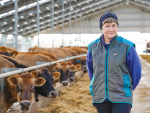
Some farmers are taking on additional work off farm to keep up with rising interest costs, says Federated Farmers dairy chair Richard McIntyre.
He points out that while the price of some farm inputs such as nitrogen fertiliser, fuel and palm kernel expeller (PKE) are starting to ease, there is still a lot of stress amongst farmers, particularly those with higher levels of debt.
"Many have come off fixed interest rates and the significantly higher interest payments are really starting to bite," he told Dairy News.
"We are hearing of farmers beginning to take on additional work off farm to keep up with their rising interest costs."
McIntyre warns that any drop in the milk price will exacerbate the problem.
His comments came as economists review their forecast milk price for the season following another drop in Global Dairy Trade (GDT) price index.
Westpac senior agri economist Nathan Penny says there are not clear downside risks to its ambitious 2023-24 milk price forecast of $8.90/kgMS.
"As a result, our forecast is under review," he says.
Penny says the downward price trend is clear and has been sustained much longer than expected, with overall prices falling at 10 of the 14 auctions held this year.
"And overall and whole milk powder (WMP) prices are down 22% and 17% in annual change terms. In contrast, we had expected that prices would have bottomed by now, if not begun to turn higher."
Penny says the chief catalyst for the ongoing price decline is the sluggish Chinese economy.
ANZ agri economist Susan Kilsby believes that prices will not materially increase before a large proportion of the current season's supply is traded.
"What is clear is that consumer demand is being impacted by weaker economic conditions in many regions.
"Most economies are still growing, albeit at a considerably slower pace than normal, which is taking a toll on dairy demand," says Kilsby.
"The softer demand from China is having the largest impact, as China is by far the world's largest importer of dairy products."
Kilsby says the bank is now forwcasting a milk price of $7.75/kgMS for the season, a drop of 50c. Fonterra is forecasting a price range of $7.25 to $8.75 for the season.
McIntyre syas it is concerning to see that banks are reducing their forecast milk price.
However, it's the processors' forecasts and the resulting change to the advance rates that will have the biggest impact, he warns.