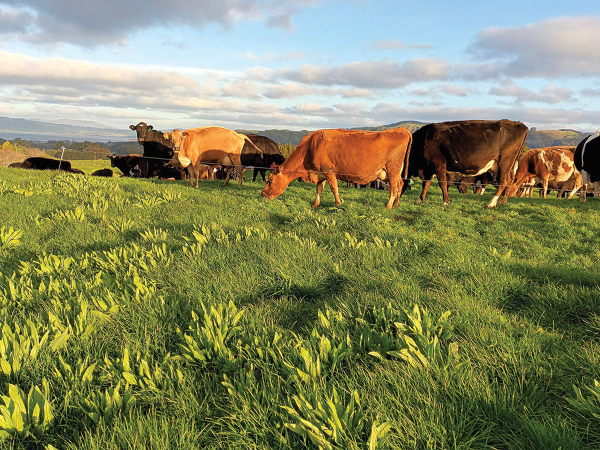
DairyNZ says its plantain programme continues to deliver promising results, with new data confirming that modest levels of plantain in pastures reduce nitrogen leaching, offering farmers a practical, science-backed tool to meet environmental goals.
With three years now complete, preliminary findings from the Lincoln University farmlet trial show 26% reduction in nitrate (N) leaching with an average of 17% Ecotain plantain in the pasture. Results from the Massey farmlet trial show over four years, N leaching was reduced on average by 26% where Ecotain plantain made up an average 25% in the pasture.
Monitoring on four mid-Canterbury farms shows that an average of 10-15% plantain across the whole farm is achievable by including plantain as part of the seed mix at pasture renewal and by broadcasting seed across the whole farm with fertiliser. The highest levels (20-40% plantain) are achieved in new swards 1-2 years after establishment.
The programme continues to show that plantain is a low-cost option to achieve significant reductions in N leaching without impacting the farm system, explains Kate Fransen, DairyNZ's plantain programme lead.
"Nitrogen leaching is an issue for many dairy catchments, so we need practical, affordable solutions. Including plantain in your pasture is 'low-hanging fruit' for reducing N leaching - and we now know you don't need to have 30% plantain in your pasture to have the positive effect.
"Research shows that 17% plantain across the farm is enough to make a sizeable difference to N leaching, and that between 10 and 20% plantain across the farm is achievable and practical for many farmers," she says.
The final year of data collection is underway at the Lincoln site, while at Massey data collection is complete and final analysis is underway. The programme now turns its focus to adoption of plantain in targeted N sensitive catchments.
Read More: