
Lanaco and Blueair Launch World-First NZ Wool Air Filter
New Zealand wool is reaching new heights as air filtration companies move away from synthetic products to biodegradable alternatives.
 increase font size
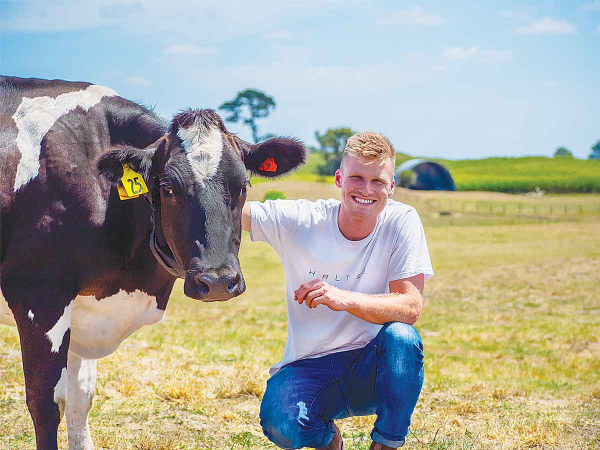 Halter founder Craig Piggott claims his company’s technology will allow for more precise pasture allocation per cow.
A smartphone application claims to allow cows to be managed without fences and by the touch of a button.
Smart-cow start-up Halter is a solar-powered, GPS-enabled collar for cows that enables farmers to shift, manage and monitor their herds remotely.
After three years of testing on their pilot farm in Morrinsville, Halter is currently working with a select number of dairy farmers in the Waikato to try it out.
Using a patented technology called ‘Cowgorithim’, the collar guides cows around a farm using sound and vibrations, creates virtual fences and even alerts farmers to health issues. Halter enables farmers to fence off areas or remotely shift herds with the touch of a button.
Now the technology has added a new pasture management feature to enable the smarter collection, synthesis and ‘actioning’ of data. Coupled with virtual fencing (no more reels and standards), the company claims this will allow for more precise kgDM or pasture allocation per cow.
Halter founder Craig Piggott says pasture management was a problem he was determined to solve.
“Farmers want to grow and harvest more grass, but labour and time constraints along with a lack of viable technology, has always made it extremely difficult for farmers to effectively manage pasture,” Piggott says.
“In an ideal world, farmers would have the technology that enables them to allocate the exact amount of pasture that an individual cow requires, all while showing how these grazing decisions will affect them not only now, but in the future.”
He claims Halter will essentially offer that ideal world.
“It’s not only going to help farmers use the grass on their farms more efficiently, it’s also going to massively reduce their workloads.”
Growing up on a dairy farm, Piggott learnt first-hand the huge workload farmer’s face on a daily basis.
And farmers say it certainly will. Pete Morgan who runs 630 cows in the Waikato can’t wait to start using Halter.
“This app will save me around three hours of work a day. Right now, I’m incredibly challenged to find enough time and labour to manage the farm,” he says. “The ability to control herd movement and drafting remotely, while using virtual break fences to precisely manage grazing will profoundly reduce my workload.”
Halter is working towards rolling out their collars nationally as they begin their operation in the Waikato this year.
The collars are paid under a subscription model, where the collar is free and farmers contribute a monthly fee per cow – based on the features they want enabled. Halter retains ownership of the collars and takes responsibility for their maintenance.
More about Halter
Halter was founded in 2016 by Craig Piggott; he says the company is made up of a diverse team.
Over the last three years, the team has grown to a group of over 40 designers, engineers, data scientists, farmers and businesspeople, who are split between the company’s headquarters in Auckland and test farm in Morrinsville.
Halter’s most recent hire is Simon Young, formerly chief technology and product officer at TradeMe.
The company is backed by Founders Fund (Peter Thiel’s venture capital firm) along with Rocket Lab’s Peter Beck and Sir Stephen Tindall, from New Zealand’s K1W1 Fund.
New Zealand wool is reaching new heights as air filtration companies move away from synthetic products to biodegradable alternatives.

Generative AI in the workplace, trials in the field, and industry-relevant research took centre stage at this year’s Grape Days events in Central Otago, Hawke’s Bay and Marlborough.
Virtual fencing company Halter is going global but for founder Craig Piggott, New Zealand farmers will always remain their main partners.
Use of agricultural drones by contractors in New Zealand is soaring.
OPINION: New technologies can promise the world but how do we know if they are delivering?


Federated Farmers has welcomed new rural policies released by ACT, saying they align closely with its own election priorities.

Rural Contractors NZ says proposed changes to land transport rules for agricultural vehicles are a welcome response by the Government to out of date regulations which have seen members hit with huge fines.
Alliance is calling for final applications for its 2027 Graduate Programme, with applications closing on Sunday 25 October.
Decades piloting planes has ensured vet and farmer David Hayes is focused on safety. So, after a serious accident while welding on farm, he is sharing his experience so others can learn from it.
Canterbury milk processor, Synlait Milk has confirmed Leon Fung as its chief executive officer.
OPINION: Making it easier to collect rainwater and use it to grow crops and livestock is a no brainer.