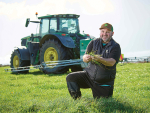
Boots Off, Brains Unplugged
OPINION: Across the country, farmers are juggling stock, pasture, animal health, fertiliser, contractors, staff, weather, cash flow and an endless list of jobs that cannot wait.
 increase font size

Both sides claimed a victory of sorts in a recent High Court case that tested the criteria for labelling phosphate rock as reactive phosphate rock (RPR) in the New Zealand market.
The case was between fertiliser companies Ballance Agri-Nutrients and Quin Environmentals. The former claimed the latter had breached the Fair Trading Act by marketing its Algerian RPR as an RPR product when it hadn’t met the necessary Citsol Test standard required in the Fertmark Code.
While the court clearly ruled that Quin had in fact breached the act and that it could not market its Algerian RPR without a clear qualifying disclaimer about it not meeting the Citsol Test, it did allow Quin to continue to market the product as an RPR (subject to the qualifier), because it otherwise has the physical properties of an RPR. Quin sees this part of the ruling as a “win for science”.
The court also noted in passing that the Citsol Test used as the Fertmark Code criteria for defining what an RPR is in the NZ context is somewhat “arbitrary” and that the Fertiliser Quality Council appears to be moving towards an alternative test – the Watkinson Dissolution Test – which the Algerian phosphate rock scores well in.
However, the court noted it could only rule on the central issue at hand, which was whether or not Quin had failed to meet the Fertmark Code as it stands and therefore breached the Fair Trading Act.
It ruled that the code is currently the industry-accepted standard and that Quin had breached the act with some of its advertising. Ballance sees this as a win for certification standards, saying it brought proceedings in a bid to “maintain the integrity of the Fertmark Code”.
So what is the Citsol Test and why did the court accept, at least in passing, that it may not be the most relevant measure of a RPR? In brief, the test measures the amount of phosphate that can be extracted from a solution of 2% citric acid mixed with a fixed quantity of phosphate rock (not ground up). To meet the Fertmark product classification as RPR, the rock must be shown to contain 30% P by the 30 minute Citsol Test.
While Quin’s Algerian ‘V2’ RPR product – with reduced dolomite to ensure it meets the Citsol standard – passed this test, its other Algerian phosphate rock produced results below 30% P – 27.28% and 28% in tests done by Marsden Agri; 25.20% and 26.19% in tests done by Ballance.
The judge’s comments about the Citsol Test came partly in response to the counterclaim brought by Quin, which claimed Ballance’s Hi P RPR is not a natural RPR product because it is a blend of Sechura RPR and ‘PB3’, which is derived from a phosphate rock but is not an RPR.
Even though the Hi P RPR product is a blend, the judge accepted it was still a phosphate rock and that it passes the Citsol Test, and therefore dismissed the counterclaim, making this observation: “The Hi P RPR example does however show the rather arbitrary nature of the reliance on the Citsol Test for determining what is RPR in New Zealand.”
OPINION: Across the country, farmers are juggling stock, pasture, animal health, fertiliser, contractors, staff, weather, cash flow and an endless list of jobs that cannot wait.

An independent importer says National’s fertiliser security policy will only work if protects all players.
Farmer-owned fertiliser company, Ballance Agri Nutrients is welcoming National’s plan to negotiate security agreements with key supplier countries to protect New Zealand-bound products from export restrictions and greater supply chain certainty.
Ballance Agri-Nutrients has released its latest fertiliser outlook, detailing some of the current global trends influencing fertiliser supply. Ballance head of procurement Shane Crean takes part in a Q&A in the report:
Ballance Agrinutrients chief executive Kelvin Wickham says despite a tough year, he is pleased the business has returned to profit.



Three men have been sentenced in District Courts after Ministry for Primary Industries prosecutions over animal welfare, food safety and cattle tracing offences.
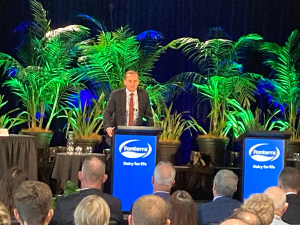
Fonterra’s 2026 financial year was a year of delivery, with record volumes of milk collected, processed and shipped by the co-op.
OPINION: The Government's decision to reinstate agriculture and horticultural science as a standalone subject from Year 11 is the right one.
Dairy farmers, still holding onto their Fonterra shares despite switching milk supply elsewhere or exiting the industry, now face a stricter share sell-down requirement.
Hamilton-based agritech company Aimer Farming has completed a $3 million capital raise to support its next stage of growth, including a beef farming product due to launch in 2027.
When dairy manager Miriam Lauridsen learned the farm, she was joining held weekly health and safety meetings, she initially thought that was “a bit over the top”. Experiencing that culture changed her mind.