Federated Farmers Praises Labour's Emissions Tax Backdown
For the first time in a quarter of a century, Federated Farmers has something positive to say about the Labour Party’s climate change policy leading into a general election.
 increase font size
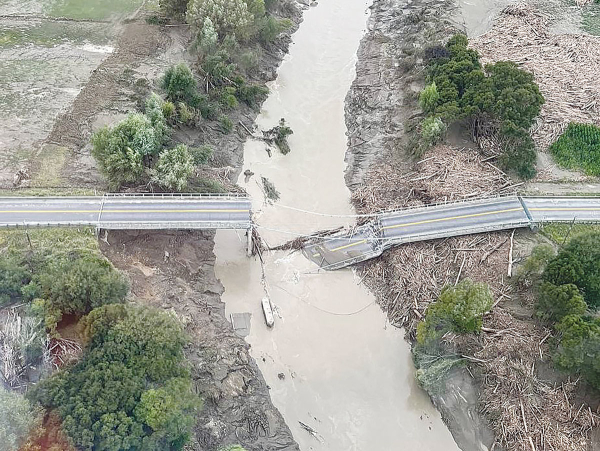 Tony Orman argues that natural climate cycles with warming and cooling and extreme weather events have always been. Photo Credit: Chorus.
OPINION: Leo Cooney's opinion article (December 5) “Carbon Credits a Discredit” rekindled for me questions about climate change, the ETS, and indeed the whole matter of climate change formerly known as global warming.
There is much confusion as to distinguishing the actual man-induced impact.
I have pondered why the term “global warming” reverted to “climate change”? That in itself is confusing. Climate change has always been happening in cyclic fashion.
There’s scientific evidence.
In scientist George Gibbs’ comprehensive and fascinating book Ghosts of Gondwana the astonishing revelation that about 15 to 20 million years ago, in Central Otago, there was a large freshwater lake ecosystem that by evidence of fossils, had crocodiles, turtles, eucalyptus trees and other warm species. “Their presence is indicative of a sub-tropical dry climate,” wrote Gibbs.
The climate must have warmed to allow sub-tropical species to not only exist but thrive. Then it cooled to its present day climate of cold winters and hot summers – again proof of the dynamics of climate change.
There have always been periods of climate change – warming and cooling.
In the 1980s a hydrologist/ botanist Dr Patrick Grant chanced upon early missionary-explorer William Colenso’s observations of the Ruahine Range in the 1840s. Grant was intrigued.
Catchment boards and extreme green groups like Forest and Bird had long blamed the “extensive land slips” and “creek beds choked with dead trees and masses of stone” on wild deer. But Colenso’s diaries clearly showed the land slips and choked stream beds had been there decades before the first deer were liberated.
So, Grant set about researching the causes. The clue was in climate. By 1985, he had defined at least seven periods of accelerated erosion since the great Taupo eruption 1800 years ago.”
The warm periods are often accompanied by severe storms such as Cyclone Alison (1975) and Cyclone Bola (1988). In the Pohangina saddle in the Ruahine Ranges, during Cyclone Allison, a rainfall gauge recorded a 24 hour rainfall of 400mm (16 inches).
William Colenso’s diaries testify tropical cyclones and extreme weather events are by no means a recent phenomenon.
Grant wrote in his book Hawke’s Bay Forests of Yesteryear, published 1996, that the erosion Colenso saw in the 1840s “was no doubt the effects of gales and heavy rainfalls.”
He scientifically identified eight “warm erosion” periods stretching back to 350-450 AD. Between warm erosion periods generally being 50 to 100 years each, “are cooler, tranquil intervals.”
So much for tropical Cyclone Gabrielle. Perhaps it was just another of many, over many centuries? Natural climate cycles with warming and cooling and extreme weather events have always been.
The problem I have with the current alarm calls being sounded about climate change is the lack of distinguishing between natural climate change and human induced climate change.
In his article Leo Cooney wrote “the so-called experts are only taking selective sequestration of carbon into their equation” and went on to add “if all sequestration was measured, such as from all our plants - including pasture.”
Bizarrely, the government’s Emissions Trading Scheme (ETS) ignores the carbon sequestering value of pasture and in a bizarre, illogical rule, any trees or shrubs under 5 metres tall are excluded from sequestering calculations. Yet many native plants are, even at maturity, under 5 metres in height.
Tony Orman is a Marlborough-based agricultural journalist and has had some two dozen books published on trout fishing, deerstalking and conservation.
For the first time in a quarter of a century, Federated Farmers has something positive to say about the Labour Party’s climate change policy leading into a general election.
Climate, nature and animal wellbeing make up Fonterra's refreshed sustainability roadmap released last week.
A five-year study has found that the cost of reducing emissions without technology may be significant and unsustainable for Northland dairy farmers.
OPINION: With the winter months officially here, I trust all is well at your place.
OPINION: The global crusade against fossil fuel is gaining momentum in some regions.


Pāmu has released its FY26 Integrated Annual Report, reporting a Net Operating Profit of $113 million, more than double the $49 million recorded in FY25.

Meat Industry Association data, released alongside the Red Meat Sector conference in Wellington, shows export value climbing across the US, China, UK and Canada.
Applications are set to open for the 2027 Zanda McDonald Award, a trans-Tasman award recognised for identifying and fast-tracking talented young leaders in agriculture and agribusiness.
The Royal New Zealand College of General Practitioners (the College) and Hauora Taiwhenua Rural Health Network are calling for investment in a proposed new training pathway for rural GPs, warning that many rural practices are struggling to recruit while a large share of the existing workforce nears retirement.
Federated Farmers has called on Central Otago District Council (CODC) to drop or vote down a plan to truck sludge from Alexandra and Cromwell to farmland near Lauder, warning it would compound an "outrageous" situation created by a separate council's decision weeks earlier.
Synlait has swung to second-half profit as operations stabilise, but the dairy processor still posted a $75.4m annual loss.