Pick-your-own becomes new floral trend
As the summer wedding season picks up, a new trend has come to the fore: Picking your own wedding flowers.
 increase font size
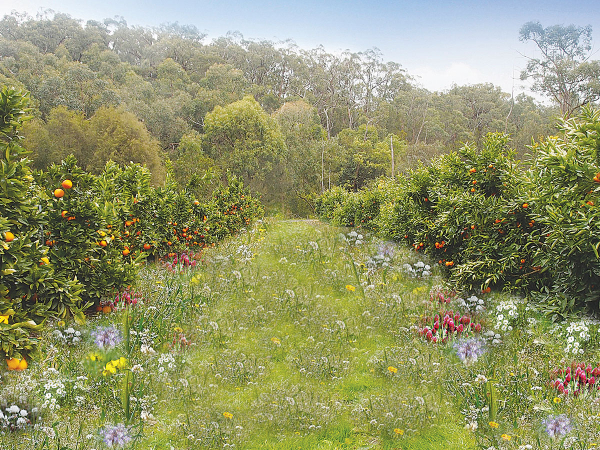 A project in Gisborne is exploring an organic method of dealing with pests on citrus orchards by understorey planting of flowers to attract beneficial insects.
A Gisborne based project is exploring an organic method of dealing with pests on citrus orchards by understorey planting to attract beneficial insects.
The two-year project is part of a $27 million, seven-year programme called A Lighter Touch, backed by the horticulture industry and Government through the Ministry for Primary Industries’ (MPI) Sustainable Food and Fibre Futures fund. It aims to shift the focus from traditional crop protection by conducting research, understanding crop protection products, and integrating biological and ecological processes into food production in New Zealand.
“Leaving bare earth under citrus trees and intensively mowing the strips between orchard rows may become a thing of the past as we revolutionise our approach through strategic planting,” says A Lighter Touch project manager Jeff Smith.
“Ranging from flowering perennials [clovers, alyssum] to annuals [buckwheat, phacelia] we’ve undertaken trials planting under and beside the trees. These plants and others may hold the key to enhance our agroecosystem and provide resources for beneficial insects to thrive which would reduce the need for applications of chemicals.”
The project has brought in researchers from Lincoln University and Plant & Food Research who extensively reviewed current literature on how to plant to attract the natural enemies of our most persistent pests. The researchers are now translating theory into practice.
“We’re testing to see what works under New Zealand conditions,” says Smith. “Seeds were planted late last year on two trial sites – one in a valley and one on the plains – alongside two control sites.”
The plains planting struggled to establish but the valley planting was more successful.
“This was because there was more rainfall in the valley and the landowner also had sheep which trampled seed into the soil.
“In future we may look at autumn sowing to see if we can achieve more consistent establishment.”
Smith says the programme is regularly collecting data on the trial and control sites including fortnightly monitoring for insect presence and species.
“By spring we’ll be able to evaluate how effective the planting has been in the first year… We’ve found that so many growers want to find a better way of planting, with less reliance on chemicals. While citrus was chosen for the model system, our findings should be adaptable for other perennial growing systems.”
As the summer wedding season picks up, a new trend has come to the fore: Picking your own wedding flowers.

In an industry estimated to be worth up to US$9 billion a year, offering the highest quality flowers possible is at the forefront of any operation.
Strautmann Hopkins Ltd imports a full range of trailed or self-propelled Strautmann Mixer Wagons from the German manufacturer.
Over the years, Ashburton-based Rotowiper has pursued one main objective – to design and manufacture an effective, cost-efficient method of controlling/eradicating weeds in pasture and crops.
For many years, reducing soil compaction has been recognised as an efficient way of increasing production for grassland and arable operations.



The New Zealand Institute of Forestry (NZIF) says unnecessary changes to New Zealand’s Emissions Trading Scheme (NZ ETS) will seriously erode investor confidence and result in significant reductions in forest planting rates.

For the first time in a quarter of a century, Federated Farmers has something positive to say about the Labour Party’s climate change policy leading into a general election.
A warning for New Zealand seed and grain companies – be prepared for an exodus of farmers from the arable sector.
Now in its fourth year, the 2026 Fencing Industry Awards, formed part of the proceedings of the FCANZ Conference, held in Nelson during August.
DairyNZ deputy chair Cameron Henderson has been re-appointed unopposed for another term.
OPINION: The stats speak for themselves.