Pāmu and Meet the Need Launch Mince Recipe Cards for Food Banks
A partnership between state-owned enterprise Pāmu (Landcorp Farming Limited) and charity Meet the Need is putting more than quality New Zealand beef into food bank parcels this year.
 increase font size

TALL FESCUE is increasingly becoming the pasture of choice on some of Landcorp’s Northland farms in the face of increasingly severe summer droughts.
Managers at the company’s Kaipiro station 16 km northeast of Kerikeri and Sweetwater station 10 km northwest of Kaitaia have put in more of the perennial grass on their dairy platforms after discovering its capabilities in recent long dry summers.
The SOE’s experimentation with fescue in the north started 12 years ago when Sweetwater station manager Mark Johnson replaced 60ha of the property’s 977ha dairy platform with the variety Advance.
He found that where production off rye and kikuyu grass struggled on the predominantly peat soils in the area’s hot summers, the tall fescue kept growing. The result was a lift in milk production every time the cows went into a paddock of the alternative pasture.
Today, fescue is the main pasture, occupying about 600ha or 60% of the platform, and Johnson hopes to increase that to 80% over the next two years.
Seeing the success Johnson was having, Kaipiro manager Andrew Kirk made an initial planting of 25ha of Advance’s successor, Excel, three years ago, and by the end of this milking season will be up to 300 ha.
Once established, fescue grows quickly throughout the year which can make it difficult to manage in a round, particularly if there are only one or two paddocks of it. Let it get too long and it becomes much less palatable so the “round” needs to be shorter than on ryegrass, 14-17 days being the norm for fescue. Even that isn’t always fast enough in spring, making topping or heavy mob grazing necessary to achieve target residuals and maintain pasture quality.
Johnson says all their fescue paddocks get topped once a year somewhere between September and November as a matter of course. Some scruffier paddocks are shut-up for silage.
“But we usually mow ahead of the cows and they clean it up ok.”
The only time ryegrass grows faster than the fescue is in late winter and early spring and even then it’s only about 10kgDM/day difference, he adds.
In spring the fescue will do 70-100 kgDM/day, and come summer it will still produce 70kgDM/day “when ryegrass will not grow much more than 20.”
But while the plant is more heat resistant than ryegrass and will grow through summer, than can be its downfall: as ‘the only green thing on the farm’ can easily get over grazed resulting in a pasture that should last at least six to eight years dying out in two or three, warns Landcorp agronomist Matthew Keltie.
At Sweetwater, under Johnson’s management, fescue still makes up 60% of the sward in some pastures nine years after sowing, despite invasive species like kikuyu being present.
“These are still high performing paddocks,” says Johnson.
He pulls cows off the fescue as soon as the residual gets down to 1500 in summer to protect the plant. Doing that’s less of a problem now a significant part of the farm is in the species.
“When we only had 40-50% of flats in fescue and it was the only thing green in summer the residuals did get down because of a too short rotation length,” he admits.
A partnership between state-owned enterprise Pāmu (Landcorp Farming Limited) and charity Meet the Need is putting more than quality New Zealand beef into food bank parcels this year.

State farmer Pamu has delivered its strongest operating result on record.
How to save soil, living with kikuyu grass and retaining nutrients on farm.
State farmer Pāmu (Landcorp) has announced it will pay a $10 million special dividend to the Crown off the back of a strong outlook for the business and a capital repayment of $9.5 million following Fonterra's consumer business sale.
The Government has appointed three new members to the board of state farmer Landcorp Farming Ltd, trading as Pāmu.


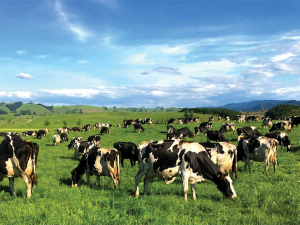
Most dairy regions around the country have had a pretty good season so far says Tracy Brown.

Rural leader Mark Hooper has been appointed as an independent director to the NZPork board, bringing extensive farming, governance and advocacy experience to the role.
Opportunity says its land value tax (LVT) is unlikely to force farmers into a position where asset sales or increased debt are required.
Milk powder prices are keeping farmgate prices up, helping processors offset the dip in milk fat prices.
Climate, nature and animal wellbeing make up Fonterra's refreshed sustainability roadmap released last week.
The Government is introducing a new nationwide rural recycling scheme that will significantly increase the recovery of farm plastics from March next year, Minister for the Environment Nicola Grigg announced today.