Efficient Irrigation Improves Pasture Productivity
Increased competition for water means the whole community is looking at how irrigators use water.
 increase font size
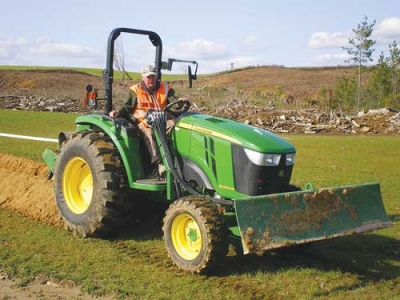 The JD 4066M tractor is doing all the work.
When Smythe Contractors, Hautapu, recently won the contract to install the irrigation system for the new second drier being constructed at Fonterra Lichfield, it was a case of déjà vu.
In 1995, when the first drier was commissioned in a record nine months, Smythe installed the irrigation system for that plant – but that pales into insignificance when you look at the current project.
Lichfield now produces 63,000 tonnes of cheese a year – easily recognisable names such as Gouda, Edam, Cheddar and Parmesan. The new plant will have the capacity to handle 4.4 million litres of raw milk a day and convert it into 700 tonnes of whole milk powder at a rate of 30 tonnes an hour, employing 50 full time workers.
With this production comes waste water output of 10mL/day, which must be dealt with effectively and efficiently – all the while maintaining good environmental practice.
The solution is the Lichfield Farm, Waratah Block, west of the factory. It is now being transformed into a 360ha area of 36 paddocks, as old forestry stands are cleaned up and the land re-contoured.
The $6.5m contract to build the 160km irrigation system will take 10-12 months to complete. It will move factory waste water – treated to remove solids and nitrates – out onto the farm via three 250mm diameter mains, subdivided into 200mm branch lines, 100mm field mains and 50m risers. The ever reducing diameters ensure constant pressure of 7bar, though testing is carried out at 12.5bar.
Final spacing in the paddock is around 20m, with 150 sprinklers per block and necessitating the installation of 5400 risers. All branch lines and field mains will be controlled by electrically actuated valves controlled at the factory, which will also monitor the amounts of liquid applied per hectare.
The irrigation job is underway, helped by a new John Deere 4066M tractor fitted with a Trench-it chain trencher. The machine deals well with the underground rocks and tree stumps littering the area.
Power comes from a 4-cyl 66hp Yanmar diesel with the latest Tier 4 specs, driving through a three-stage hydrostatic transmission with cruise control, which enables it to maintain slow forward speeds required by the trencher. Close-coupled to the tractor is the 2-inch pitch chain, rated to 50,000kg capacity. This cuts a clean 300mm trench down to around 1m, then after pipe laying the front four-way blade does the backfilling.
The final tidy-up is done with a home-made compactor on the front of a tractor – a large diameter steel wheel which can be filled with water to increase weight. This is driven down the trench line after the backfilling.
Increased competition for water means the whole community is looking at how irrigators use water.
Moves are afoot to get a team of Australians over here to help repair North Canterbury's irrigation machinery, ravaged by the big windstorm of late October.
Horticulture New Zealand (HortNZ) says access to reliable irrigation water is essential for a thriving horticultural sector.
A 100-year-old Canadian irrigation district has taken inspiration from Canterbury irrigation company Central Plains Water's success in converting from an open race irrigation system to a gravity-fed piped system.
Effluent is a valuable source of nutrients.



Celebrating 50 years in the rural landscape of Central Canterbury and beyond, Ashburton-based Carrfields, has been the exemplar for all aspects of modern agriculture via its extensive range of services including supply, growing, agronomic advice and marketing.

For Taupiri dairy farmers Logan and Sian Dawson, their involvement in the NZ Dairy Industry Awards has been a key catalyst in the growth of their business - the experience helping shape how they approach the farm ownership pathway they are pursuing today.
West Otago dairy farmer Luke Kane has been awarded the 2026 Rabobank Dr John Morris Business Development Prize.
OPINION: As the general election approaches, political parties are churning out policies in the hope of attracting more votes.
An LIC bull, Tronnoco AR Sadio-ET S3F, bred by Tony and Keri O'Connor of Tronnoco Farming Co Ltd near Timaru, has won the 2026 Mahoe Trophy.
With forecasters advising El Niño conditions will develop through winter and strengthen into spring and summer, Ballance Agri-Nutrients is encouraging farmers and growers to think ahead about nutrient planning and be prepared to work around challenging weather conditions.