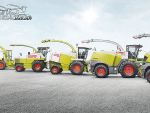
50 years of Jaguar forage harvesters
Anyone with a little grey hair, or in my case, very little hair, will remember the early 1970s, when they likely saw their first self-propelled forage harvester.
 increase font size

JAGUAR'S RETURN to the racetrack, with its Jaguar Heritage Racing, is a first since 1956.
Works-supported C- and D-types will race at Goodwood and the Nurburgring.
The first event Jaguar Heritage Racing will contest is the 2012 Mille Miglia retrospective in May, important to the company as it marks 60 years since Sir Stirling Moss and Norman Dewis (then Jaguar's chief development driver) took the start in the first
disc-brake equipped C-type car.
Later that year Moss gained the first win for a disc-braked car, a C-type at Reims.
In August the team will compete at the AVD Nurburgring Old-timer Grand Prix – the 'green hell' – one of the toughest tracks in the world, Jaguar says. Then it will race at the Goodwood Revival in September.
Historic motorsport 'revivalist' JD Classics will prepare the C and D-type Jaguars.
Along with that is Jaguar Heritage, a charitable trust and custodian of Jaguars including the unique XJ13 prototype.
Such cars
are not raced but are exhibited and demonstrated.
Jaguar has won the Le Mans 24 hour race seven times.
Anyone with a little grey hair, or in my case, very little hair, will remember the early 1970s, when they likely saw their first self-propelled forage harvester.
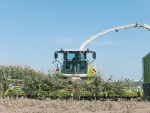
Claas has improved its industry-leading Jaguar self-propelled forage harvesters, including advanced engine and control technologies and a tyre pressure control system for the drive and steering axles.
The Jaguar XE has been named ‘Most Beautiful Car of 2014’ at Festival Automobile International in Paris.
JAGUAR DISPLAYED an XKR coupe with a difference in New York recently.
JAGUAR'S COUPE, the XK, has a higher luxury specification for 2012 and includes a new top-of-the-range XKR-S with performance described as "formidable" for a Grand Tourer coupe and convertible.
In Portfolio specification the XKR-S has new soft-grain leather upholstery, heated and cooled seats, heated steering wheel, a suede headlining and an 8-speaker Bowers and Wilkins 525 watts sound system as standard.
The latest XK, in all its derivations, is recognisable by its thinner Xenon headlights and LED running lights and turn signals. There is a larger grille and new front bumper.
There are five new paints in the 17 colour range and the choice of 11 different alloy wheels from 19 to 20 inches diameter.
The Portfolio coupe and convertible models are available for $175,000 and $190,000 respectively. Apart from the new features detailed above, these have adaptive dynamic suspension, sequential shift with steering column paddles for the 6-speed automatic transmission behind the 283 kWs five litre V8.
The XKR comes with a supercharged version of the V8 motor producing 375kW and 625Nm torque. Added features include an active differential, 'R' performance brakes, quad tail pipes and the 'R' exterior. These will sell for $195,000 and $210,000 for coupe and convertible respectively.
The range topping XKR-S has been awarded '2011 Sports Car of the Year' by the respected German motoring magazine, Auto Bild Sportscars, following a poll of 70,000 readers.
Its 5L supercharged V8 engine produces 412kW and 680Nm, giving it 0-100km/h in 4.4 seconds. Top speed is 300km/h.
The cars have aluminium body shells for better economy, agility and performance.


Federated Farmers says it welcomes Labour's commitment to reviewing the Sharemilking Agreements Act, calling on other major parties to do the same.
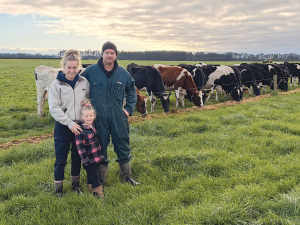
For Canterbury dairy farmers Sian Meijer and Rick Wobben, wearable technology has become one of their most valuable on-farm tools - helping manage 1850 cows across an expansive, high-performing dairy operation while improving efficiency, mating outcomes and day-to-day decision making.
Fonterra has unveiled its annual results for the 2026 financial year, posting $27 billion in revenue and close to $20 billion returned to New Zealand farmer owners and unit holders.
The first major update to the Dairy Cattle Code of Welfare in more than a decade has been released, marking what DairyNZ describes as an important step in ensuring animal welfare standards continue to evolve alongside scientific evidence and on-farm realities.
Ravensdown shareholders have elected Jane Montgomery and Kate Acland to the Ravensdown Board for three-year terms, following a closely contested director election.
Federated Farmers says new legislation replacing the Resource Management Act will cut red tape, unlock investment and help grow New Zealand's export-led economy, after the Planning Bill and Natural Environment Bill passed their third reading in Parliament yesterday.