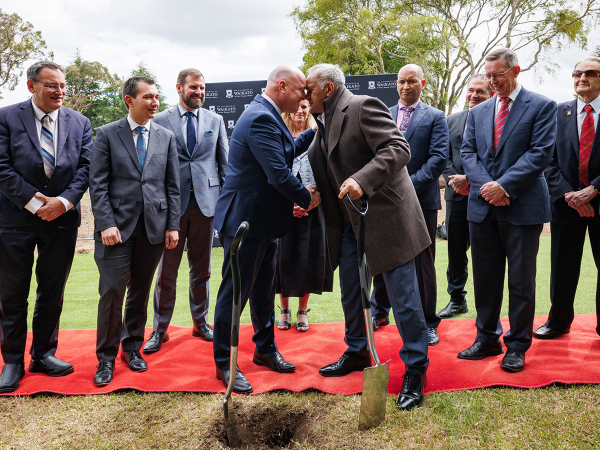
The University of Waikato has broken ground on its new medical school building.
The groundbreaking ceremony, attended by Prime Minister Christopher Luxon, Minister for Universities Dr Shane Reti and Minister of Health Simeon Brown, marks a key milestone in the establishment of the New Zealand Graduate School of Medicine which is set to welcome its first students in 2028.
The four-storey teaching and learning building is where medical students will spend their first year in the four-year programme studying biomedical sciences and the social factors that influence health.
The medical school will take a ‘digital-first’ approach, using innovative teaching practices and new technologies.
This approach will be enabled by the facility’s purpose-built learning environments such as digital anatomy labs, VR-enabled case study rooms, clinical skills practice areas and hospital-standard simulation wards.
Students will learn in small, collaborative groups, supported by advanced digital tools such as VR and clinical simulation labs, alongside top-quality staff.
University of Waikato vice-chancellor Neil Quigley says he is pleased the university has taken the step towards opening New Zealand's first graduate-entry medical school.
“We’re committed to delivering a medical school that will attract more people who want to train to be doctors in primary and community care," Quigley says.
"We’re committed to delivering a medical school that will attract more people who want to train to be doctors in primary and community care," he adds.
Health Minister Simeon Brown says the opening is an important step in the Government's plan to train more general practice doctors and strengthen access to primary care in regional New Zealand.
"It’s an important day for the University of Waikato, for regional development, and for the future of primary healthcare in our communities," he says.
In recent months the University has taken key steps towards the establishment of the medical school including the appointment of an expert Medical Advisory Board which brings together expertise across general practice, rural and community health, psychiatry, equity and health technology.
It has signed an MOU with the University of Wollongong to collaborate on curriculum development, drawing on Wollongong’s success in training doctors for rural and regional areas, and has partnered with the University of Canterbury to expand opportunities for student placements into the South Island.
Its engagement with rural and regional communities across the country to finalise clinical placement locations is ongoing, with these set to be finalised in June 2026.
Construction of the building is expected to be complete in December 2027.