Ah Tatua, You've Done It Again!
Waikato milk processor Tatua has again declared a record milk payout to farmer shareholders, leaving other processors in the dust.
 increase font size
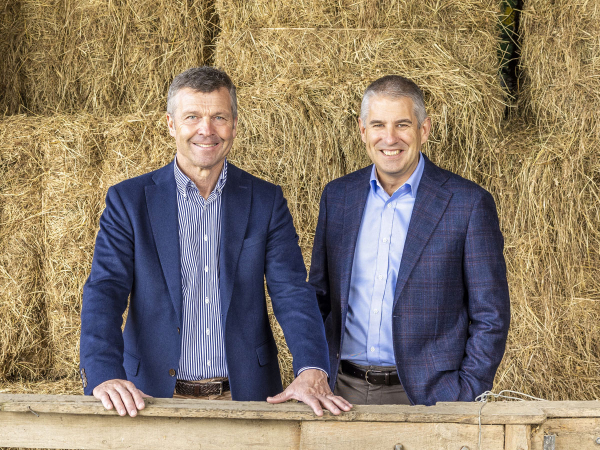 Tatua chairman Stephen Allen (left) and chief executive Brendhan Greaney say they are pleased to report another good year.
Another season, another record milk payout from Tatua.
The dairy co-operative has paid its 101 shareholder farms a whopping $12.30/kgMS for milk supplied last season, again leaving Fonterra and other processors in the dust in the payout stakes.
Morrinsville-based Tatua's earnings for the 2022-23 season equated to $15.20/kgMS before retention. The co-op has retained $2.90/kgMS or $43 million for reinvestment in the business.
Last year, Tatua paid its suppliers $11.30/kgMS, retaining $1.35/kgMS.
Fonterra last month announced a final milk price of $8.22/kgS plus a dividend of 50c/share.
It was at pains to point out that it returned 50c/share to shareholders and unit holders, giving a final cash payout to farmers of $9.22 per share-backed kgMS.
In a joint statement, Tatua chairman Stephen Allen and chief executive Brendhan Greaney say they are pleased to report that Tatua has had another good year.
"In deciding our payout, we have sought to balance the needs of our shareholders' farming businesses, in an environment where costs have increased well beyond mainstream inflation, and our need to continue to invest in the business while also maintaining balance sheet strength."
Tatua's gearing ratio averaged 21.7% for the year, but lowered to 16% at balance date, following the sale of higher than typical inventory levels.
The company added that in addition to achieving record income and earnings, good progress has been made in many areas of the business - including a number of significant capital projects and business improvement initiatives.
"Our teams in New Zealand and in our offshore subsidiaries have continued to demonstrate their commitment and dedication to the business and this is reflected in all that has been achieved," Allen and Greaney says.
Tatua's income reached a record $537 million, with earnings available for a payout of $225 million.
"Revenue from our bulk ingredients business of caseinate, whey protein concentrate (WPC) and anhydrous milkfat (AMF) was the highest ever, buoyed by global dairy protein prices, which contributed significantly to our earnings uplift."
However, the company warns that prices have subsequently fallen, which will result in more typical earnings over the year ahead.
"The bulk ingredients revenue uplift coincided with combined revenue from our inherently more stable specialised nutritionals, foods and flavours businesses also reaching a new high, and making a valuable contribution to overall earnings."
Tatua processed 14.85 million kgMS last season, 1% higher than the previous season. However, it says the season was a game of two halves.
"Wet conditions and lack of sunshine early in the season severely impacted supply, with milk received over the peak supply period 6.6% behind.
"Fortunately, those same wet conditions helped boost milk supply later in the season, to end 1% higher than the previous season overall."
Waikato milk processor Tatua has again declared a record milk payout to farmer shareholders, leaving other processors in the dust.

Tatua chair Stephen Allen says he leaves the co-op with a deep sense of gratitude for the people who have contributed to its success.
Tatua Co-operative Dairy Company has confirmed that chair and director Stephen Allen will retire at the co-operative's annual general meeting (AGM) on 3 December 2026, ending 30 years of service, including more than 20 years as Chair.
Independent Waikato milk processor Tatua has set another new record for conventional farmgate milk price paid to New Zealand farmers.
OPINION: Earlier this month, small Waikato milk processor Tatua reminded the country that it’s still number one when it comes to paying farmers for their milk.


Waikato milk processor Tatua has again declared a record milk payout to farmer shareholders, leaving other processors in the dust.

A Labour-led Government won’t be bringing back the controversial freshwater rules of 2020.
National’s much-touted free trade deal with India featured in the Rural Issues Debate at Mystery Creek, Hamilton on Wednesday night.
New Zealand's 2026-27 freshwater fishing season has opened, with anglers encouraged to head to rivers and lakes over the coming days as conditions look favourable across much of the country.
Central Otago District Council (CODC) has voted against a plan to spread treated sewage sludge from Cromwell and Alexandra on farmland near Lauder, a decision Federated Farmers says reflects strong opposition from rural residents.
Pāmu has released its FY26 Integrated Annual Report, reporting a Net Operating Profit of $113 million, more than double the $49 million recorded in FY25.