Beef + Lamb New Zealand Awards 2026 Winners Announced in Christchurch
Last night saw the winners of the 2026 Beef + Lamb New Zealand (B+LNZ) Awards named at a gala dinner at Te Pae Christchurch Convention Centre.
 increase font size
 Dr Sara Edwards.
How to get better reproductive performance from hoggets is the question AgResearch animal reproduction scientists at Invermay are seeking to answer.
Reproduction team leader Dr Sara Edwards says a lot of work has been done to try to improve efficiency of hogget lambing using management practices, but the underlying questions remained as to what was going wrong and why the reproductive performance of hoggets is so variable.
The trial was conducted over two years at the Invermay farm, and followed industry best practice recommendations for hogget management.
"We ran two groups of animals over two years, which were mated as hoggets then as two-tooths, and we compared their performance and looked at things that were difficult to look at on commercial farms," she says.
"These included whether they had attained puberty, what their ovulation rate was and how many embryos survived to around Day 35. As two-tooths the same things were measured, apart from puberty, so they could be compared."
Dr Edwards says then did very close shepherding at lambing, to record exactly what happened to every lamb, then followed the lambs through to weaning.
"What we found was that hoggets have a lower ovulation rate than 2-tooths. This affects the maximum number of lambs they can produce, so the reproductive performance is low to begin with," she says.
"In addition, we had a reasonable number of animals that, although they were ovulating, were not being mated. They were either not seeking the ram or not showing the characteristics of oestrus. They also had a higher degree of fertilisation failure or embryo loss. They had more embryo loss by Day 35 but from then on we found no differences in pregnancy loss or lamb survival between the hoggets and the two-tooths."
In terms of next steps, the team has some early data which suggests that increasing the ovulation rate using genetics could lead to more lambs being born. They are also testing other methods of increasing the ovulation rate, and are looking at ways to increase the number of animals that get mated. These include studying ram behaviour and mob mating.
"Some farmers are doing a really good job of growing the hoggets so that they successfully produce lambs, but there is still a gap between the performance of hoggets and mature ewes. Now we know where the gap comes from we are trying to find ways of make it smaller," says Dr Edwards.
The paper "Reduced ovulation rate, failure to be mated and fertilization failure/embryo loss are the underlying causes of poor reproductive performance in juvenile ewes" is scheduled to be published in the April edition of the journal Animal Reproduction Science http://dx.doi.org/10.1016/j.anireprosci.2016.02.017
Last night saw the winners of the 2026 Beef + Lamb New Zealand (B+LNZ) Awards named at a gala dinner at Te Pae Christchurch Convention Centre.

With lamb prices at record highs, many farmers are considering breeding their ewe hoggets for the first time.
A significant breakthrough in understanding facial eczema (FE) in livestock brings New Zealand closer to reducing the disease’s devastating impact on farmers, animals, and rural communities.
A breakthrough in the understanding of Facial Eczema (FE) in livestock could bring New Zealand closer to reducing the disease’s impact.
An innovative idea for transforming mechanically deboned meat (MDM) into a meat flake for seasoning has taken top honours in the Meat Industry Association’s (MIA) first-ever Dragon’s Den competition.


Red meat farmers are welcoming Labour’s plan to review the Emissions Trading Scheme and not to campaign on pricing agricultural emissions.
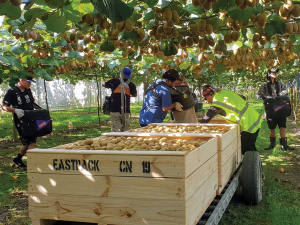
Where any worker in the kiwifruit industry is mistreated, we expect the authorities to take action.
Mid Canterbury Federated Farmers arable chair, Bevan Lill, said Beef + Lamb NZ data indicated that for the last six years, the average arable return on investment was about 0.8% while inflation ran about 4% - so the average arable farm was going backwards at about 3% a year.
Seed and grain companies share the concerns of arable farmers about the viability of their sector, says Seed and Grain New Zealand chief executive Dr Sarah Clark.
The New Zealand Institute of Forestry (NZIF) says unnecessary changes to New Zealand’s Emissions Trading Scheme (NZ ETS) will seriously erode investor confidence and result in significant reductions in forest planting rates.
For the first time in a quarter of a century, Federated Farmers has something positive to say about the Labour Party’s climate change policy leading into a general election.