State farmer posts record results
State farmer Pamu has delivered its strongest operating result on record.
 increase font size
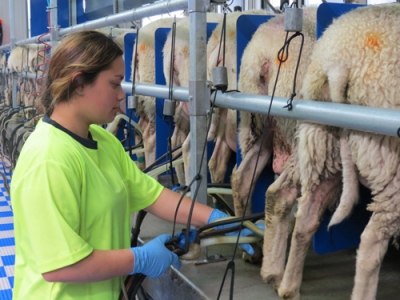 Milking at the St Kilda farm in the north Taupo area.
Landcorp chief executive Steven Carden says his company plans to set up a second sheep milking farm on one of their properties near Taupo.
Landcorp have recently begun milking 2,700 East Fresian ewes at their St Kilda farm in the north Taupo area. Carden says while this is in some ways a pilot project, the aspiration of the company is to make this into a substantial business and an industry in its own right. Spring Sheep Dairy as it is known, is a joint venture with the agribusiness investment company SLC Group to produce high quality sheep milk for mostly Asian markets.
In just eight months Landcorp has achieved the almost impossible by turning bare pasture land north of Taupo into one of the world's most high tech sheep milking operations.
Twenty two year old Thomas Macdonald, a Landcorp business manager has project managed this unique $3.9 million greenfield operation which includes the building of the new shed, the purchase of stock and recruitment of a manager, five full time staff and twenty casual staff.
The milk is being processed by Waikato Innovation in Hamilton.
Unlike a typical cow shed, the sheep milking shed is quiet, there is less water being used because there is less effluent and the milking of each sheep is over in just a couple of minutes. This shed can milk 1000 sheep an hour. Milking is twice a day. But it's the array of technology that catches the eye of first time visitors to the shed.
"This parlour was built from the ground up with technology in mind. We have got individual metering of animals per day we are the first one the world to measure fat protein per animal per day," says Macdonald.
It's the data gathered in the shed which will later to be used to select the best animals to breed from in the future. At present about half the flock being milked are pure East Fresian with remainder crosses and milk production varies between these, with the pure breds producing about two litres at each milking and some of the crosses about 500mls. The aim is to produce a much higher yielding flock with surplus lambs being reared for the meat industry.
State farmer Pamu has delivered its strongest operating result on record.

State farmer Pāmu (Landcorp) has announced it will pay a $10 million special dividend to the Crown off the back of a strong outlook for the business and a capital repayment of $9.5 million following Fonterra's consumer business sale.
Sheep infant nutrition maker Blue River Dairy is hoping to use its success in China as a springboard into other markets in future.
Sheep milk processor Maui Milk is on track to record average ewe production of 500 litres by 2030, says outgoing chief executive Greg Hamill.
The Government has appointed three new members to the board of state farmer Landcorp Farming Ltd, trading as Pāmu.



Testing confirms H5 bird flu in a single northern giant petrel, found dead on a remote Cape Palliser beach in the Wairarapa, says Dr Mary van Andel, the Ministry for Primary Industries' (MPI) Chief Veterinary Officer.

"What's for dinner?" may sound like a simple question, but for many Kiwi parents, answering it has become a job in itself.
Fifty Eight years ago, on the 16th of August 1968, August Claas, the founder of the harvesting company and father of Helmut Claas, personally presented a Claas Senator combine harvester to Scottish farmer John Steven.
New Zealand consumers are paying more for beef mince than ever before, with the average retail price now sitting above $24 per kilogram, according to Rabobank.
State farmer Pamu has delivered its strongest operating result on record.
Four years since it was first detected in New Zealand, researchers and growers now know much more about management of maize pest fall armyworm (FAW).