Barry Cuttance Suspension: Inside the NZDFA Dispute
A spat within the ranks of the New Zealand Deer Farmers Association has resulted in the suspension of outspoken North Canterbury farmer Barry Cuttance.
 increase font size
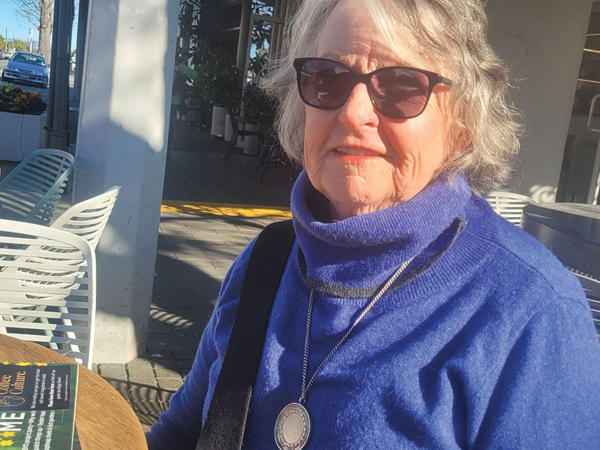 Libby Judson remembers the last draught horse used on their farm at Swannanoa, Canterbury.
Libby Judson is a keeper of memories from an age gone by. Tim Fulton tells her story.
Libby's parents, Jim and Kitty, grew up on Browns Rd, next to the original Petrie family homestead in Swannanoa, not far north-west of Christchurch.
These Petries originally came from nearby Woodend, where Jim grew up in the area known as 'Five Crossroads'.
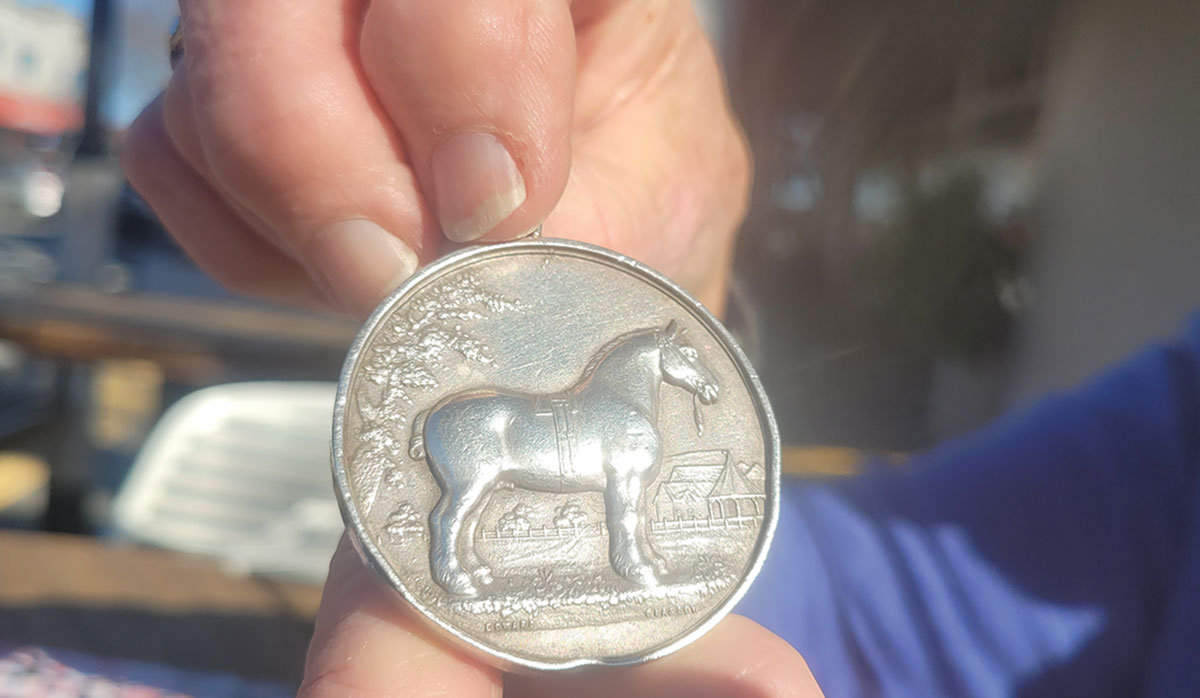
Jim farmed together with his older brother, Hugh. Both were passionate about stud sheep - Jim had Southdowns and later had a Clydesdale stud. That memory remains around Libby's neck in the form of a medal he won at the Amberley A&P Show.
Jim and Hugh were good farmers, specialising in cocksfoot and small seeds as well as wheat, barley and the like. The Eyre River beside them never burst out on farming land, though Libby, now 80, can remember the way floodwater would burst down the usually-dry river a couple of times a year.
"When it came down, it came down in a huge torrent and sometimes you could see the waves going down it from our house, about two paddocks away," she says.
Libby remembers swimming in the Eyre in the August holidays: "we were pretty tough". In another marker of the times, she had to ride a pony 8km to Swannanoa School and home from the age of 5, guided by sister Jeannie, six years older.
There were also four boys, John who died of an aneurism at only 21, when Libby was only six as well as Dugal, Dick and Graeme who lived long lives.
"I can remember John was very loving to me," Libby says. "He was training to be a surveyor and his office was down by the old Waimak bridge, the old catchment board house. The day he went up the hills for surveying, he must have shot a goose up there and he put it in our mailbox on our big old mailbox on North Eyre Rd. That night he died in his sleep."
Libby's father, Jim also farmed sheep on about 80ha on the corner of Two Chain Rd and Woodfields Rd, near where the Larsens now farm extensively. When Libby came along, all the draught horses had been changed to tractors but she can remember the last draught horse; her name was Flora.
Jim was a keen dog breeder with a kind streak: he would give pups to other farmers rather than selling them. He was also passionate about dog trialing, which served as a common interest for so many local farmers of the time.
Swannanoa was an isolated area in the '50s: Tram Rd was shingle, Swannanoa School had less than 20 pupils at one point and the Eyreton branch train line along North Eyre Rd took passengers and freight. Libby swears she could hear trains coming by putting an ear to the track.
"Because we didn't have a school bus, when we had to go by car, or walk or ride a pony. The Education Board used to pay my father and mother a certain amount for our ponies to be shod."
And it was hard to get a blacksmit: old Charlie Cattermore at Fernside did the job and the kids had to ride to his place to get the poinies shod. "We'd have to have a day off school to go down there and shoe them."
Her brothers used to go to school in a pony cart, picking up the Larsen children and Janet Frizzell on the way. "One day they train came along and they must have thought the pony would be okay but she reared up, jumped the fence and left the cart on the other side. My father was very angry because they broke the shafts on the cart."
Later, when her brothers were ploughing near the railway line, they'd turn over coal from the steam engines.
The original Swannanoa School building, now part of the hall across Tram Rd, was still in the school grounds in Libby's time.
"My father was on the school committee and also on the baths committee that builtg those lovely baths, which are still going, I can still remember the men building them and my mother taught me to swim in there. She used to get me to put my hands round her neck and I'd swim on her back."
Mother Kitty was made a Life Member of the Women's Division of Federated Farmers (now Rural Women New Zealand). Sister Jeannie received the honour too.
"Women's Division used to do so much for the community, helping young mothers and all sorts of things."
Fun and Adventure
Libby Judson, the youngest child, revelled in adventures to and from Swannanoa School, stopping in the afternoons at the pine plantation on the corner of Tram Rd and Two Chain.
"There was a house over the road but we'd go down to the boundary of Dick Frizzells' where we'd build huts and take little violet plants, trying to grow them. Just have half an hour or so there before we headed home after schoool.
"My sister had to cart me home unconscious one day, when I was only six or seven and came off a pony. The first pony I had. Sally, was 12-2 hands. Dad had backed her for me and I'm not very tall.
"This pony was not a nice - she used to try and go under trees and pull me off. She was given or sold to the Luisettis in Rangiora. The next pony, which Dad bred, was called Sixpence. I've got a photo her at the Christchurch show - that was the first year I rode at the show."
Sixpence was a sour little pony and father Jim was very concerned about horses getting foundered, when they get heat in their hooves from autumn and spring grass. "It's like us getting a smashed fingernail; it's so painful and makes them lame."
 |
|---|
|
A medal Libby's father, Clydesdale breeder Jim Petrie, won at the Amberley A&P Show. |
So next thing Jim bought two yearlings from his friend, Mal Jenkins, who was a war veteran.
Jim couldn't go to war because he had an enlarged heart and he was needed as a farmer: instead he served in the Home Guard.
These two yearlings arrived; 13-2 hands high which is a medium-size pony. "These two ponies were put in the top paddock, where they lived for a year before they were touched to be broken in."
Once Mr Jinks was broken in, Libby had to ride him home. (Mr Jinks was named after the breeder, Mr Jenkins.) "I rode from Fernside, with a man riding beside me. Mr Jinks was the most amazing pony - he was school pony and I had another pony which Dad bought off Malcolm Jenkins the following year. She was called Gleam."
Libby would ride each horse alternately, one day at a time. "My father would get me to ride the one I wasn't riding to school for about two rounds, round the paddock, then go and have my breakfast before leaving at quarter to eight to ride to school. Then I'd come home and I'd ride that pony again, because he believed in fitness in horses."
Those two ponies one championships - and I was at the start of one-day eventing with them. "Mr Jinks was a tremendous jumper and I used to hunt: when I was six I went to my first hunt, Brackenfield."
Taking Part in Local Sport
Libby Judson and her siblings invariably got involved in local sport growing up. The Petrie boys played rugby for Rangiora: Graeme was a hooker who played for years, Dick was a goal-kicking fullback and Dugal played too.
The Petrie's home farm at Swannanoa, Eyredale, was mortgage-free. When the boys were old enough, Jim bought about 400ha over by the Dixons at Claxby - at an attractive price of 10 Pounds per acre.
"It had been left for years and years. The paddocks were about 40ha each. My brothers would go over there, leaving about 7.30, through the riverbed to Claxby from the middle of our farm. They wouldn't get home till probably 7 o'clock at night."
Libby's oldest surviving brother, Dugal, ended up doing a lot of fencing, working for Harry Sidey in the Hurunui. He then worked for well-known harness racer, Bill Doyle, who had about 800ha at Doyleston in Selwyn, and he did a stint with the McPhersons in Cheviot. "I had a holiday there with Dugal and I was able to ride all round the farm with him, which was quite exciting because it was hilly."
Libby went to Rangi Ruru School in Christchurch, as a day pupil. They refused to let her board because of mileage criteria. "I had to private board for three years and that was horrible: I had one lovely lady in the middle of my time who was very homely but the other two were not like that. But I was very lucky because I was allowed to get home in the weekends and ride my ponies."
A spat within the ranks of the New Zealand Deer Farmers Association has resulted in the suspension of outspoken North Canterbury farmer Barry Cuttance.
Efficiency is the big one because it tracks back into what is done on farm.
Twenty five secondary school students from around New Zealand recently completed a three day residential programme designed to explore career opportunities across the food and fibre production supply chain.
Cameron Reed lives between two worlds.
Improving health and safety is about incremental gain rather than a sudden decision, says Leeston farmer and Federated Farmers health and safety spokesman David Birkett.

An Auckland gelato shop and an established New Zealand ice cream maker have both been named Supreme Champions at the NZ Ice Cream & Gelato Awards 2026.

As the cost-of-living crisis continues to put pressure on household grocery budgets, new figures show pork remains one of the most affordable fresh meat options for New Zealand families.
OPINION: In politics, credibility is and should be big. It must surely rank higher than charisma, which is quite trite and superficial. Yet, voters nowadays are often wooed and influenced by how someone looks or talks at a superficial level. TV plays a huge role in this.
Farmers can spend less time on paperwork, thanks to a new data sharing agreement between DairyNZ’s DairyBase and LIC’s MINDA software.
Kaikōura families affected by July's severe storm have found a practical solution to a problem that's kept some children away from regular schooling for weeks: a washed-out section of Inland Kaikōura Road, which has stopped the local school bus from running its usual route.
Rural New Zealand is welcoming the Government’s recent package of rural healthcare initiatives.