Layered Plan Needed To Fight BVD
Bovine Viral Diarrhoea (BVD) is sometimes viewed as a dairy industry issue, but the reality is that the disease can have serious consequences for beef breeding herds as well.
 increase font size
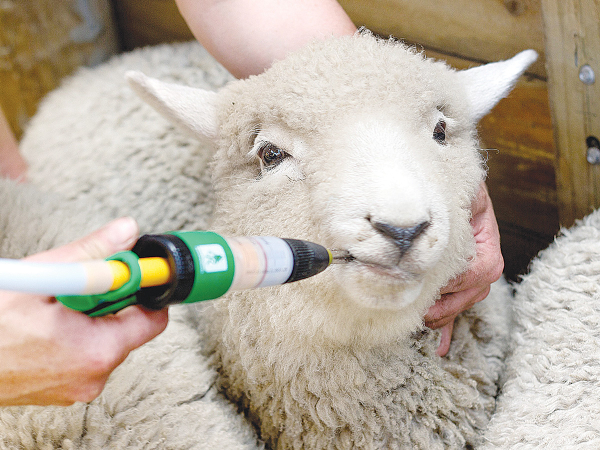 When ewes are at an optimum BSC they are much better able to buffer a parasite challenge.
Sheep farmers who would normally treat ewes with drench capsules before lambing are being urged to reconsider before reaching for the next long-acting alternative.
Earlier this year the popular Bionic drench capsule was banned for use by the Ministry for Primary Industries, following concerns around the rate of release of drug from the product.
Other long-acting alternatives are available, but this could be a chance to push the ‘reset’ button on the use of these products, says vet and Beef+Lamb New Zealand Wormwise manager Ginny Dodunski.
In an era of widespread drench resistance, Dodunski says if ewes are well-fed at an optimum Body Condition Score (BCS) and are not grazing pastures heavily contaminated by internal parasite larvae, then a long-acting pre-lamb drench should not be necessary.
She says in the weeks prior to lambing and during early lactation, ewes are more prone to losing their innate immunity to worms.
How much this impacts on the ewe and her production and economic outcomes depends on a number of factors.
The first of these is the amount of feed on offer at lambing and in the weeks immediately prior to lambing.
“You will get a production response from giving ewes a long-acting drench if they are underfed, but if you really nail the feeding, get grass covers right at set-stocking and the grass coming up under the ewes after lambing, then the need for a long-acting drench product drops off.”
She says another factor to consider before picking up the drench gun is body condition. When ewes are at an optimum BSC of 3–3.5 (or above) then they are much better able to buffer a parasite challenge and farmers are less likely to get an economic response from treating those animals.
 |
|---|
|
Wormwise manager Ginny Dodunski says if ewes are well-fed at an optimum Body Condition Score, then a long-acting pre-lamb drench should not be necessary. |
“There are a lot of good reasons for maximising the number of ewes at a BCS of 3–3.5 in the flock.”
A third factor to consider is the level of worm contamination on the pasture being carried into late winter and spring.
There will be production penalties if under-stress ewes are fighting off thousands of worm larvae ingested with every mouthful.
This is more likely when ewes are grazing pastures that have been grazed by lambs over autumn and winter.
Ultimately, Dodunski would like to see routine pre-lambing drenching become irrelevant by shifting the focus to optimal feeding and management.
“A strategy for this season could be to separate multiple-bearing ewes on body condition score and only treat those who are under BCS 3 – with the aim of reducing the proportion of these ewes at pre-lamb time next year”.
Bovine Viral Diarrhoea (BVD) is sometimes viewed as a dairy industry issue, but the reality is that the disease can have serious consequences for beef breeding herds as well.

When Simon Hales discovered triple drench resistance on his Weber farm, it was a catalyst to fast-track farm system change.
Body Condition Score (BCS) is a critical element in managing the health and reproduction of the dairy herd.
Bull management involves ensuring the right number of healthy bulls for your herd, minimising stress and reducing injury risks.
It's easy to look over a lush spring paddock and assume cows are getting enough usable nutrition. But while fast-growing pasture can give plenty of volume, in high moisture, variable dry matter and uneven mineral profile can leave real nutrition gaps when cows need it most.



OPINION: In politics, credibility is and should be big. It must surely rank higher than charisma, which is quite trite and superficial. Yet, voters nowadays are often wooed and influenced by how someone looks or talks at a superficial level. TV plays a huge role in this.

Farmers can spend less time on paperwork, thanks to a new data sharing agreement between DairyNZ’s DairyBase and LIC’s MINDA software.
Kaikōura families affected by July's severe storm have found a practical solution to a problem that's kept some children away from regular schooling for weeks: a washed-out section of Inland Kaikōura Road, which has stopped the local school bus from running its usual route.
Rural New Zealand is welcoming the Government’s recent package of rural healthcare initiatives.
Interest in agritech and production animal systems has prompted Massey University's School of Agriculture and the Environment to new majors to its popular animal science degree.
Ballance Agrinutrients chief executive Kelvin Wickham says despite a tough year, he is pleased the business has returned to profit.