
Almond Hulls Trialled to Cut Dairy Cow Emissions in NZ
Almond hulls sourced from Australian orchards may have the potential to help New Zealand cows reduce emissions, boost milk yield and lower input costs.
 increase font size
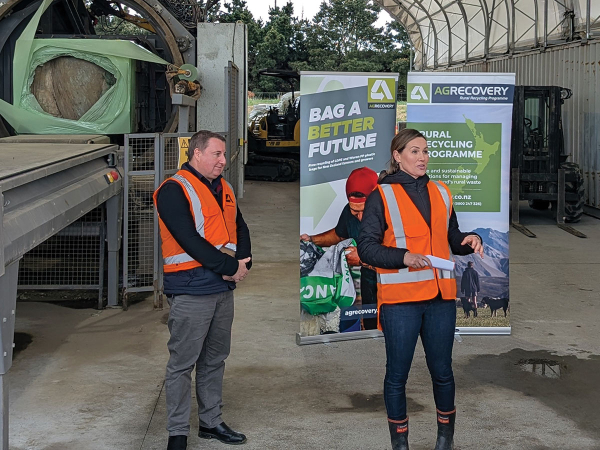 Environment Minister Nicola Grigg announces the new Rural Recycling Scheme alongside AgRecovery CEO Tony Wilson at a plastics recovery site at Yaldhurst.
Environment Minister Nicola Grigg has announced details of a new rural plastics recycling scheme.
Speaking during a visit to a plastics recovery facility near Christchurch, she said the new nationwide rural recycling scheme will significantly increase the recovery of farm plastics.
“The new, regulated Rural Recycling Scheme will expand recycling and recovery of agrichemical containers, bale wrap and silage sheet, with a new nationwide take-back system replacing the current voluntary recycling schemes.
“The scheme has been designed by industry and - with the support of farmers - will significantly increase the recovery and recycling of farm plastics. It will be managed by the not-for-profit Agrecovery Foundation.
“We’ve listened to feedback from farmers and growers who wanted a simple take-back system that is easy to use and can take all the usual plastic farm products into one recycling.
Grigg said voluntary schemes operated by Agrecovery and Plasback currently collect less than half of the in-scope plastics that farmers and growers use. The new system would significantly reduce the quantity of farm plastics going to landfills, being buried or burned on farms.
The scheme will require the producers of plastic waste – companies which supply products such as silage wraps, or fertilisers and agrichemicals in plastic packaging – to contribute a small fee, typically around 1% or less of the full product price, to support a free, nationwide network of collection sites and services.
The existing regional network of around 240 take-back sites will be expanded to cater to the increased volume.
“Recycling services will operate in tandem with collection services for agrichemicals, making it easier to safely manage unused end-of-life products,” said Grigg.
“Take-back services will also be available to other users of agrichemicals and farm plastics including the forestry, manufacturing, hospitality, tourism and sport sectors, and local authorities and contractors. Households will also have a bespoke national service for their pest and weed control products.”
Agrecovery CEO Tony Wilson told Rural News that their polling showed 90% of farmers supported the scheme.
Existing voluntary schemes will continue to operate until the regulated scheme starts on March 1, 2027.
The regulations will require participation in the scheme by all producers of regulated products, including:
The regulations target products mostly used in agricultural settings and a small subset of agrichemicals used by households. Products that may be used in significant volume by other industries – for example sanitisers and detergents not unique to the agricultural sector – are not targeted by the regulations but producers and manufacturers from any sector can voluntarily participate.
Almond hulls sourced from Australian orchards may have the potential to help New Zealand cows reduce emissions, boost milk yield and lower input costs.

The Government is introducing a new nationwide rural recycling scheme that will significantly increase the recovery of farm plastics from March next year, Minister for the Environment Nicola Grigg announced today.
The Ballance Farm Environment Awards are coming to the West Coast of the South Island.
Climate, nature and animal wellbeing make up Fonterra's refreshed sustainability roadmap released last week.
Developed in Australia and launched in 2021, John Deere’s See & Spray Select System uses camera-based green-on-brown technology to identify living green plant matter in fallow paddocks and apply herbicide only where it is needed.



A free online platform aggregating governance vacancies across rural and regional New Zealand has been launched.
Environment Minister Nicola Grigg has announced details of a new rural plastics recycling scheme.
Agricultural drone operators say that a government decision to allow lower-risk drone work without certification won’t lower standards but drive innovation and efficiency.
OPINION: Warning bells are ringing in the arable sector.
Farmgate lamb prices are down by 8%, beef cattle by 4.5% and farm expenditure up by 4.2%.
Kiwifruit growers are watchful but remain optimistic as concerns around the potential effects of the El Niño weather pattern this season.